{"extraData":"\"65668,17,13,19317,,\"","message":"成功","title":"成功","valid":"true"}<!-- 所有JSP页面都需要在页面的开始位置包含本页面 -->
<!DOCTYPE html PUBLIC "-//W3C//DTD XHTML 1.0 Transitional//EN" "http://www.w3.org/TR/xhtml1/DTD/xhtml1-transitional.dtd">
<html>
<head>
<meta http-equiv="X-UA-Compatible" content="IE=edge,chrome=1" />
<!--<meta name="viewport" content="width=device-width,initial-scale=1.0,maximum-scale=1.0,minimum-scale=1.0,user-scalable=no" />-->
<title>Screening and evaluation of antioxidants from lees by micro-injector systems combined with a fluorescent probe, <i>N</i>-borylbenzyloxycarbonyl-3, 7-dihydroxyphenoxazine, in living <i>Drosophila</i></title>
<!-- 所有JSP页面都需要在页面的开始位置包含本页面 -->
<link type="text/css" href="http://ccspublishing.org.cn:80/style/web/img/favicon.ico" rel="shortcut icon" />
<link type="text/css" href="http://ccspublishing.org.cn:80/style/web/css/bootstrap.min.css" rel="stylesheet" />
<link type="text/css" href="http://ccspublishing.org.cn:80/style/web/css/article/base.css" rel="stylesheet" />
<link type="text/css" href="http://ccspublishing.org.cn:80/style/web/css/article/triangle.css" rel="stylesheet" />
<link type="text/css" href="http://ccspublishing.org.cn:80/style/web/css/article/iconfont2.css" rel="stylesheet" />
<link type="text/css" href="http://ccspublishing.org.cn:80/style/web/css/colorbox.css" rel="stylesheet" />
<link type="text/css" href="http://ccspublishing.org.cn:80/style/web/css/swiper.min.css" rel="stylesheet" />
<link type="text/css" href="http://ccspublishing.org.cn:80/style/web/css/common.css" rel="stylesheet" />
<link type="text/css" href="http://ccspublishing.org.cn:80/style/web/css/head_foot.css" rel="stylesheet" />
<!--  <link type="text/css" href="http://ccspublishing.org.cn:80/style/web/css/main.css" rel="stylesheet" />-->

<link type="text/css" href="http://ccspublishing.org.cn:80/style/web/css/article/article_layout.css" rel="stylesheet" />
<link type="text/css" href="http://ccspublishing.org.cn:80/style/web/css/article/article.css" rel="stylesheet" />
<link type="text/css" href="http://ccspublishing.org.cn:80/style/web/css/article/imgShow.css" rel="stylesheet" />
<link type="text/css" href="http://ccspublishing.org.cn:80/style/web/css/article/imgShowIcon.css" rel="stylesheet" />

<script type="text/javascript" src="http://ccspublishing.org.cn:80/style/web/js/jquery-1.11.2.min.js"></script>
<script type="text/javascript" src="http://ccspublishing.org.cn:80/style/web/js/bootstrap.min.js"></script>
<script type="text/javascript" src="https://mathjax.xml-journal.net/platformTools/js/MathJax-master/MathJax.js?config=TeX-AMS-MML_SVG"></script>
<script type='text/x-mathjax-config'>MathJax.Hub.Config({tex2jax: {inlineMath: [['$','$'], ['\\(','\\)']]},"HTML-CSS": {linebreaks: { automatic: true},scale: 120}});</script>
<script type="text/javascript" src="http://ccspublishing.org.cn:80/style/web/js/bootstrapValidator.js"></script>
<script type="text/javascript" src="http://ccspublishing.org.cn:80/style/web/js/rhhz.js"></script>
<script type="text/javascript" src="http://ccspublishing.org.cn:80/style/web/js/base.js"></script>
<script type="text/javascript" src="http://ccspublishing.org.cn:80/style/web/js/swiperd.min.js"></script>
<script type="text/javascript" src="http://ccspublishing.org.cn:80/style/web/js/head_foot.js"></script>
<script type="text/javascript" src="http://ccspublishing.org.cn:80/style/web/js/main.js"></script>
<script type="text/javascript" src="http://ccspublishing.org.cn:80/style/web/js/search.js"></script>
<script type="text/javascript" src="http://ccspublishing.org.cn:80/style/web/js/countUp.min.js"></script>

<script type="text/javascript" src="http://ccspublishing.org.cn:80/style/web/highcharts/highcharts.js"></script>
<script type="text/javascript" src="http://ccspublishing.org.cn:80/style/web/highcharts/modules/exporting.js"></script>
<script type="text/javascript" src="http://ccspublishing.org.cn:80/style/web/js/article/json2.js"></script>
<script type="text/javascript" src="http://ccspublishing.org.cn:80/style/web/js/article/article_base.js"></script>
<script type="text/javascript" src="http://ccspublishing.org.cn:80/style/web/js/article/article.js"></script>
<script type="text/javascript" src="http://ccspublishing.org.cn:80/style/web/js/article/articles.js"></script>
<script type="text/javascript" src="http://ccspublishing.org.cn:80/style/web/js/article/imgShow.js"></script>

<script type="text/javascript" src="http://ccspublishing.org.cn:80/style/web/js/jquery.nicescroll.js"></script>
<script type="text/javascript" src="http://ccspublishing.org.cn:80/style/web/js/jquery.colorbox.js"></script>
<!--[if lt IE 9]>
<script type="text/javascript" src="http://ccspublishing.org.cn:80/style/web/js/respond.min.js"></script>
<script type="text/javascript" src="http://ccspublishing.org.cn:80/style/web/js/html5.js"></script>
<![endif]-->
<script type="text/javascript">
/**
 * 网站访问统计jsonp回调
 * @param data
 * @return
 */
//全局变量存储访问总数
var totalPv = 1;
function visitCountjsonpCallback(data){
	if(!isNull(data)){
		totalPv = data.history.pv;
	}
}
</script>
</head>

<body data-spy="scroll" data-target="#myScrollspy" class="articleBody" onload="resetHref();">
	<input type="hidden" value="qikan" id="pageViewId" />
	<input type="hidden" value="a9d994e9-6945-48d1-8a86-cf5368c525af" id="articleId" />
	<input type="hidden" value="en" id="articlelanguage"/>
	<div class="wcimgwrap" >
		<div class="wcimgcon">
			<i class="closecode2 articleFont icon-cuo"></i>
		</div>
		
	</div>
	<!--头部 开始-->
	<div id="common-top">
		<!-- 所有JSP页面都需要在页面的开始位置包含本页面 -->
<!-- header -->
<div class="header">
    <div class="logo-wrapper">
        <a href="http://ccspublishing.org.cn:80/"><img class="logo" src="http://ccspublishing.org.cn:80/style/web/imgs/img/logo.png"/></a>
    </div>
    
    <div class="banner_bottom">
        <ul class="clearfix">
            <li><b>收录期刊</b><br/>
                <span class="jumbo headerColor" id="myTargetElement"></span>种
            </li>
            <li><b>全文期刊</b><br/>
                <span class="jumbo headerColor" id="myTargetElement2"></span>种
            </li>
            <li><b>论文全文</b><br/>
                <span class="jumbo headerColor" id="myTargetElement3"></span>篇
            </li>
            <li>论文摘要<b></b><br/>
                <span class="jumbo headerColor" id="myTargetElement4"></span>条
            </li>
            <!--
            <li>注册机构<b></b><br/>
                <span class="jumbo headerColor" id="myTargetElement5"></span>个
            </li>
            <li>注册用户<b></b><br/>
                <span class="jumbo headerColor" id="myTargetElement6"></span>人
            </li>
            -->
        </ul>
    </div>
</div>


<!--nav-->
<div class="nav-content">
    <div>
        <ul class="navigation pull-left">
            <li data-page="index" class=""><a href="http://ccspublishing.org.cn:80/">首页</a></li>
              </ul>
        <div class="suspension headerBg"></div>
        <div class="other pull-right">
			<input type="hidden" id="loginPath" value="" />
			<input type="hidden" id="logoutPath" value="" /> 
			<a href="javascript:void(0);" class="login colorWhite loginBtn"><span></span>登录</a>
					<a href="javascript:void(0)" class="registerbtn colorWhite">注册</a>
					<!-- <a href="javascript:void(0);" class="chinese colorHoverW loginBtn">中文</a>-->
					<a href="http://ccspublishing.org.cn:80/?pageType=en" class="english colorWhite">English</a>
				</div>
    </div> 
</div>

<script>
	$(".loginBtn").click(function(){
		var loginPath = $("#loginPath").val();  
		var _time = Math.random();
		var local = window.location.href;
		var path = loginPath + local;  
		console.log(path); 
		//alert(path);
		window.location.href = path;	
	});
	$(".logoutBtn").click(function(){
		var path = $("#logoutPath").val();  
		console.log(path);
		//alert(path);
		window.location.href = path;	
		
	});
</script></div>
	<!--头部 结束-->

	<div class="article-header">
		<div class="header-content">
			<div class="header-left">
				<p style="font-size:16px;font-weight:bold;">Screening and evaluation of antioxidants from lees by micro-injector systems combined with a fluorescent probe, <i>N</i>-borylbenzyloxycarbonyl-3, 7-dihydroxyphenoxazine, in living <i>Drosophila</i></p>
				<p>
					<span>
							<a href="javascript:void(0);" onclick="searchLike('authorNameCn','Guangcui Chu')" target="_blank">
								Guangcui Chu</a>
							,&nbsp;</span>
					<span>
							<a href="javascript:void(0);" onclick="searchLike('authorNameCn','Dandan Cheng')" target="_blank">
								Dandan Cheng</a>
							,&nbsp;</span>
					<span>
							<a href="javascript:void(0);" onclick="searchLike('authorNameCn','Wenjuan Liu')" target="_blank">
								Wenjuan Liu</a>
							,&nbsp;</span>
					<span>
							<a href="javascript:void(0);" onclick="searchLike('authorNameCn','Xuefeng Wang')" target="_blank">
								Xuefeng Wang</a>
							,&nbsp;</span>
					<span>
							<a href="javascript:void(0);" onclick="searchLike('authorNameCn','Xiaotao Hou')" target="_blank">
								Xiaotao Hou</a>
							,&nbsp;</span>
					<span>
							<a href="javascript:void(0);" onclick="searchLike('authorNameCn','Yuanyuan Hou')" target="_blank">
								Yuanyuan Hou</a>
							,&nbsp;</span>
					<span>
							<a href="javascript:void(0);" onclick="searchLike('authorNameCn','Hongjun Wei')" target="_blank">
								Hongjun Wei</a>
							,&nbsp;</span>
					<span>
							<a href="javascript:void(0);" onclick="searchLike('authorNameCn','Jiagang Deng')" target="_blank">
								Jiagang Deng</a>
							,&nbsp;</span>
					<span>
							<a href="javascript:void(0);" onclick="searchLike('authorNameCn','Gang Bai')" target="_blank">
								Gang Bai</a>
							</span>
					</p>
			</div>
			<div class="header-right">
				<a href="javascript:void(0);" onclick="downloadpdf('a9d994e9-6945-48d1-8a86-cf5368c525af');">
					<img width="160" height="35" src="http://ccspublishing.org.cn:80/style/web/images/downloadPDF.png" alt="downloadPDF" />
				</a>
			</div>
			<a href="javascript:void(0);" class="close-header">
				<i class="close-box articleFont icon-cuo"></i>
			</a>
		</div>
	</div>


	<div class="content">
		<!--doi-->
		<div class="quot">
			<font>
				<b>Citation:&nbsp;</b>
				<span class="info" id="infoEn">
					Chu Guangcui,&nbsp;Cheng Dandan,&nbsp;Liu Wenjuan,&nbsp;Wang Xuefeng,&nbsp;Hou Xiaotao,&nbsp;Hou Yuanyuan,&nbsp;Wei Hongjun,&nbsp;Deng Jiagang,&nbsp;Bai Gang.&nbsp;Screening and evaluation of antioxidants from lees by micro-injector systems combined with a fluorescent probe, <i>N</i>-borylbenzyloxycarbonyl-3, 7-dihydroxyphenoxazine, in living <i>Drosophila</i>[J].&nbsp;<i>Chinese Chemical Letters</i>,
						2018,&nbsp;29(10):&nbsp;1521-1527.
						<span style="display:inline-block;">
							doi:<a class="mainColor" href="http://dx.doi.org/10.1016/j.cclet.2018.05.020" target="_blank" class="mainColor">
								10.1016/j.cclet.2018.05.020</a>
						</span>
					</span>
				<span class="copy-citation" onclick="copyCitationEn(this)" title="copy to clipboard">
					<img class="shu" src="http://ccspublishing.org.cn:80/style/web/images/shu.png" alt="shu" />
				</span>
			</font>
			</div>


		<div class="article">
			<!--左侧内容-->
			<div class="article-left pull-left">
				<div class="articleCn">
					<!--中文大标题-->
					
					<h2>Screening and evaluation of antioxidants from lees by micro-injector systems combined with a fluorescent probe, <i>N</i>-borylbenzyloxycarbonyl-3, 7-dihydroxyphenoxazine, in living <i>Drosophila</i></h2>
					<!--作者信息-->
					<ul class="article-author">
						<li>
								<a href="javascript:void(0);" class="mainColor" data-relate="">
									</a>
								</li>
							<li>
								<a href="javascript:void(0);" class="mainColor" data-relate="">
									</a>
								</li>
							<li>
								<a href="javascript:void(0);" class="mainColor" data-relate="">
									</a>
								</li>
							<li>
								<a href="javascript:void(0);" class="mainColor" data-relate="">
									</a>
								</li>
							<li>
								<a href="javascript:void(0);" class="mainColor" data-relate="">
									</a>
								</li>
							<li>
								<a href="javascript:void(0);" class="mainColor" data-relate="houyy@nankai.edu.cn">
									</a>
								</li>
							<li>
								<a href="javascript:void(0);" class="mainColor" data-relate="weihongjun@188.com">
									</a>
								</li>
							<li>
								<a href="javascript:void(0);" class="mainColor" data-relate="">
									</a>
								</li>
							<li>
								<a href="javascript:void(0);" class="mainColor" data-relate="">
									</a>
								</li>
							</ul>
					<ul class="about-author">
						<!-- 作者地址 -->
						<li class="article-author-address aaaa">
									<span class="">
										</span>
									<p class="lostOf">
										</p>
								</li>
							<li class="article-author-address aaab">
									<span class="">
										</span>
									<p class="lostOf">
										</p>
								</li>
							<li class="article-author-address aaac">
									<span class="">
										</span>
									<p class="lostOf">
										</p>
								</li>
							<li class="article-author-address aaad">
									<span class="">
										</span>
									<p class="lostOf">
										</p>
								</li>
							<!-- fn start -->
						<!-- fn end -->
						<!-- 通讯作者和作者简介 -->
						<h6 class="com-author-info">
									<b>通讯作者:</b>
									,
											<a class="mainColor" href="mailto:houyy@nankai.edu.cn">houyy@nankai.edu.cn</a><br/>
										,
											<a class="mainColor" href="mailto:weihongjun@188.com">weihongjun@188.com</a><br/>
										</h6>
							</ul>

					<div class="article-box article-box1">
						</div>
				</div>
				<!--中文信息  结束-->
                <h3 class="open-English">
					<b><span class="open-or-close">
						<i class="articleFont icon-jia"></i>
					</span>English</b>
				</h3>
				
				<!--英文信息  开始-->
				<div class="articleEn" hidden>
					<!-- 英文大标题 -->
					<h2>Screening and evaluation of antioxidants from lees by micro-injector systems combined with a fluorescent probe, <i>N</i>-borylbenzyloxycarbonyl-3, 7-dihydroxyphenoxazine, in living <i>Drosophila</i></h2>
					<!-- 作者信息 -->
					
					<!-- 如果所有英文作者为空，那就不显示作者地址 -->
					<ul class="article-author">
						<li>
									<a href="http://ccspublishing.org.cn:80/search/author?author=Chu Guangcui" class="mainColor" data-relate="">
										Chu Guangcui</a>
									<sup class="authorTag">
										<a href="javascript:void(0);" title="" class="com-num" data-tagVal="a">
												a</a>,
	                            		</sup>
									,</li>
							<li>
									<a href="http://ccspublishing.org.cn:80/search/author?author=Cheng Dandan" class="mainColor" data-relate="">
										Cheng Dandan</a>
									<sup class="authorTag">
										<a href="javascript:void(0);" title="" class="com-num" data-tagVal="a">
												a</a>,
	                            		</sup>
									,</li>
							<li>
									<a href="http://ccspublishing.org.cn:80/search/author?author=Liu Wenjuan" class="mainColor" data-relate="">
										Liu Wenjuan</a>
									<sup class="authorTag">
										<a href="javascript:void(0);" title="" class="com-num" data-tagVal="a">
												a</a>,
	                            		</sup>
									,</li>
							<li>
									<a href="http://ccspublishing.org.cn:80/search/author?author=Wang Xuefeng" class="mainColor" data-relate="">
										Wang Xuefeng</a>
									<sup class="authorTag">
										<a href="javascript:void(0);" title="" class="com-num" data-tagVal="b">
												b</a>,
	                            		</sup>
									,</li>
							<li>
									<a href="http://ccspublishing.org.cn:80/search/author?author=Hou Xiaotao" class="mainColor" data-relate="">
										Hou Xiaotao</a>
									<sup class="authorTag">
										<a href="javascript:void(0);" title="" class="com-num" data-tagVal="c">
												c</a>,
	                            		</sup>
									,</li>
							<li>
									<a href="http://ccspublishing.org.cn:80/search/author?author=Hou Yuanyuan" class="mainColor" data-relate="houyy@nankai.edu.cn">
										Hou Yuanyuan</a>
									<sup class="authorTag">
										<a href="javascript:void(0);" title="" class="com-num" data-tagVal="b">
												b</a>,
	                            		<a href="javascript:void(0);" class="com-user" title="Corresponding author:&nbsp;Hou Yuanyuan,&nbsp;houyy@nankai.edu.cn"></a>,
	                            		<a href="mailto:houyy@nankai.edu.cn" class="com-mail" title="mailto: houyy@nankai.edu.cn"></a>
										</sup>
									,</li>
							<li>
									<a href="http://ccspublishing.org.cn:80/search/author?author=Wei Hongjun" class="mainColor" data-relate="weihongjun@188.com">
										Wei Hongjun</a>
									<sup class="authorTag">
										<a href="javascript:void(0);" title="" class="com-num" data-tagVal="d">
												d</a>,
	                            		<a href="javascript:void(0);" class="com-user" title="Corresponding author:&nbsp;Wei Hongjun,&nbsp;weihongjun@188.com"></a>,
	                            		<a href="mailto:weihongjun@188.com" class="com-mail" title="mailto: weihongjun@188.com"></a>
										</sup>
									,</li>
							<li>
									<a href="http://ccspublishing.org.cn:80/search/author?author=Deng Jiagang" class="mainColor" data-relate="">
										Deng Jiagang</a>
									<sup class="authorTag">
										<a href="javascript:void(0);" title="" class="com-num" data-tagVal="c">
												c</a>,
	                            		</sup>
									,</li>
							<li>
									<a href="http://ccspublishing.org.cn:80/search/author?author=Bai Gang" class="mainColor" data-relate="">
										Bai Gang</a>
									<sup class="authorTag">
										<a href="javascript:void(0);" title="" class="com-num" data-tagVal="b">
												b</a>,
	                            		</sup>
									</li>
							</ul>
					<ul class="about-author">
						<!-- 英文作者地址 -->
							<li class="article-author-address aaaa">
										<span class="">
											a.
	       									</span>
										<p class="lostOf">
											Tianjin University of Traditional Chinese Medicine, Tianjin 300193, China</p>
									</li>
								<li class="article-author-address aaab">
										<span class="">
											b.
	       									</span>
										<p class="lostOf">
											State Key Laboratory of Medicinal Chemical Biology, College of Pharmacy and Tianjin Key Laboratory of Molecular Drug Research, Nankai University, Tianjin 300353, China</p>
									</li>
								<li class="article-author-address aaac">
										<span class="">
											c.
	       									</span>
										<p class="lostOf">
											Guangxi Collaborative Innovation Center of Study on Functional Ingredients of Agricultural Residues, Guangxi Key Laboratory of Efficacy Study on Chinese Materia Medica, Guangxi University of Chinese Medicine, Nanning 530200, China</p>
									</li>
								<li class="article-author-address aaad">
										<span class="">
											d.
	       									</span>
										<p class="lostOf">
											JF-Pharmaceutical Technology Development Co., Ltd., Tianjin 300457, China</p>
									</li>
								<!-- fn start -->
						
						          <!-- fn end -->
						<!-- 英文通讯作者，作者简介 -->
						<h6><b>Corresponding author:</b>
									Hou Yuanyuan,
											<a class="mainColor" href="mailto:houyy@nankai.edu.cn">houyy@nankai.edu.cn</a>
										Wei Hongjun,
											<a class="mainColor" href="mailto:weihongjun@188.com">weihongjun@188.com</a>
										</h6>
							<!-- 英文稿件日期 -->
						<li class="com-author-info">
	    					<span><b>Received Date:</b>
	    						27 March 2018</span><br/>
	    					<span><b>Accepted Date:</b>
	    						07 May 2018</span><br/>
	    					<span><b>Revised Date:</b>
	    						04 May 2018</span><br/>
	    					<span><b>Available Online:</b>
	    						22 October 2018</span>
	    					</li>
						
						</ul>

					<div class="article-box article-box1">
						<div class="article-info-en">
							<b>Abstract:</b>
								Over the past few decades, the determination of antioxidant activity by chemical probe has been widely reported, but <i>in vivo</i> evaluation <i>via</i> model organisms of Drosophila melanogaster and rapid discovery system has not been studied adequately. In this study, we determined the antioxidant activity of lees and demonstrated the ability of compounds in lees to scavenge H<sub>2</sub>O<sub>2</sub> <i>in vitro</i> and <i>in vivo</i> by different chemical probes. Lees increased the ability of Drosophila against oxidative stress and antioxidant enzyme activity <i>in vivo</i>. Five ingredients of organic acids and flavones in lees extract that rapidly scavenged H<sub>2</sub>O<sub>2</sub> were revealed by a post-column-derived HPLC-UV-FLD system based on 4-hydroxyphenylacetic acid (PHPAA) chemiluminescence. Additionally, another fluorescent probe, <i>N</i>-borylbenzyloxycarbonyl-3, 7-dihydroxyphenoxazine (NBCD), was selected to evaluate the reactive oxygen species (ROS) scavenging capacity of lees in living Drosophila melanogaster using a microfluidic injection test coupled with microscopic imaging analysis, and similar effects were observed in flies when they were treated with tartaric acid and caffeic acid. The results demonstrated that the novel integrated system was suitable for screening and evaluating antioxidant ingredients from natural products.</div>
						<ul class="article-keyword article-info-en">
								<b>Key words:</b>
								<li>
											<a class="underHigh" onclick="searchLike('keywordEn','Lees')" href="javascript:void(0);">
												Lees</a>
										</li>
									<li>
											
														&nbsp;/&nbsp;
													<a class="underHigh" onclick="searchLike('keywordEn','Antioxidant')" href="javascript:void(0);">
												Antioxidant</a>
										</li>
									<li>
											
														&nbsp;/&nbsp;
													<a class="underHigh" onclick="searchLike('keywordEn','Microinjection')" href="javascript:void(0);">
												Microinjection</a>
										</li>
									<li>
											
														&nbsp;/&nbsp;
													<a class="underHigh" onclick="searchLike('keywordEn','HPLC-UV-FLD')" href="javascript:void(0);">
												HPLC-UV-FLD</a>
										</li>
									<li>
											
														&nbsp;/&nbsp;
													<a class="underHigh" onclick="searchLike('keywordEn','NBCD')" href="javascript:void(0);">
												NBCD</a>
										</li>
									<li>
											
														&nbsp;/&nbsp;
													<a class="underHigh" onclick="searchLike('keywordEn','PHPAA')" href="javascript:void(0);">
												PHPAA</a>
										</li>
									</ul>
						</div>
				</div>
				<!--英文信息  结束-->
				<!--nav-->
					<div class="article-nav" >
						<div class="nav-wrapper">
							<div class="pull-left">
								<p></p>
								<span><b></b></span>
							</div>
							<ul class="pull-left">
	
								<!--全文-->
								<li val="HTML全文">
									<a data-navId="htmlContent" rel="html" articleId='a9d994e9-6945-48d1-8a86-cf5368c525af'
									onclick="ajaxCountHtmlView('a9d994e9-6945-48d1-8a86-cf5368c525af');" href="javascript:void(0);">
										<span></span>HTML全文<num></num>
									</a>
								</li>
								<!--pdf预览-->
								<li val="PDF预览">
	                        		<a data-navId="pdfPreview" href="javascript:void(0);">
	                        			<span></span>PDF预览<num></num>
	                        		</a>
	                        	</li>
		                  		<!--参考文献-->
								<li rel="ref" val="参考文献">
									<a data-navId="References" href="javascript:void(0);">
										<span></span>参考文献<num>(35)</num>
									</a>
								</li>
								<!--相关文章-->
								<li val="相关文章">
									<a data-navId="relative-article" href="javascript:void(0);">
										<span></span>相关文章
									</a>
								</li>
								<!--图表-->
								<li val="图表" rel="fig">
									<a data-navId="figTab" href="javascript:void(0);">
										<span></span> 
										图<num>(4)</num>
										表<num></num>
									</a>
								</li>
								<!--知识图谱-->
								<li val="知识图谱">
									<a data-navId="map" href="javascript:void(0);">
										<span></span>知识图谱<num></num>
									</a>
								</li>
	
								<!--附件-->
								<li rel="sup" val="附件">
									<a data-navId="Supplementary" href="javascript:void(0);">
										<span></span>附件<num>(0)</num>
									</a>
								</li>
								<!--访问统计-->
								<li val="访问统计" rel="metric" onclick="loadArticleMetricCount('a9d994e9-6945-48d1-8a86-cf5368c525af');">
									<a data-navId="metric_count" href="javascript:void(0);">
										<span></span>访问统计<num></num>
									</a>
								</li>
								
							</ul>
						</div>
					</div>

				<!--8个标签内容-->
					<ul class="article-box-content">
	
						<!--全文-->
						<li id="htmlContent" class="article-box current">
									<input id="basePath" type="hidden" value="/fileHXH/journal/article/ccl/2018/10/PIC/123" />
	<!-- 遍历章节列表 -->
			<!-- 输出章节标题 start -->
				<!-- 输出章节标题 end -->
		<!-- 输出章节下的段落内容start -->
					<!-- 普通段落 -->
							<p id='539c3dce-34c7-4bed-8618-c89ecf4bf10c'>Reactive oxygen species (ROS), such as hydrogen peroxide (H<sub>2</sub>O<sub>2</sub>), are important by-products of oxygen metabolites [<span class="xref"><a href="#b1" ref-type="bibr">1</a></span>]. They are vital to life, but become very harmful in the case of depletion of antioxidants, resulting in oxidative stress through the oxidation of biomolecules [<span class="xref"><a href="#b2" ref-type="bibr">2</a></span>]. It is necessary to use sensitive and selective tools to study H<sub>2</sub>O<sub>2</sub> in the living system because of its active and transient properties [<span class="xref"><a href="#b3" ref-type="bibr">3</a></span>]. The fluorescence probe is a powerful tool due to its high sensitivity, simple data acquisition in high performance liquid chromatographic (HPLC), and high spatial resolution in microscopic imaging techniques.</p>
									<!-- 图段落 -->
						<!-- 表段落 -->
						<!-- box段落 -->
								<!-- 普通段落 -->
							<p id='1fecd60c-9bb1-4cae-bbbb-3a057976d5a7'>In recent years, numerous <i>in vitro</i> online antioxidant assays have been developed to measure the radical scavenging ability of natural compounds, including HPLC-UV-ABTS [<span class="xref"><a href="#b4" ref-type="bibr">4</a></span>], HPLC-UV–DPPH [<span class="xref"><a href="#b5" ref-type="bibr">5</a></span>], HPLC-DAD-DPPH and HPLC-DAD-ABTS [<span class="xref"><a href="#b6" ref-type="bibr">6</a></span>]. In addition, the determination of peroxides by HPLC-FLD has developed gradually. For example, Guilbault proposed using horseradish peroxidase (HRP) as a catalyst and 4-hydroxyphenylacetic acid (PHPAA) as a substrate to determine peroxide [<span class="xref"><a href="#b7" ref-type="bibr">7</a></span>]. Qi <i>et al</i>. [<span class="xref"><a href="#b8" ref-type="bibr">8</a></span>] reported the catalysis of a hemin substitute for HRP in a post-column-derived HPLC system. The common feature of these methods is that all antioxidants or peroxides are separated by a chromatographic approach, but normally, data about antioxidant capacity that are generated by <i>in vitro</i> methods cannot be extrapolated to <i>in vivo</i> effects, and most <i>in vitro</i> chemical processes are not relevant for <i>in vivo</i> conditions [<span class="xref"><a href="#b9" ref-type="bibr">9</a></span>].</p>
									<!-- 图段落 -->
						<!-- 表段落 -->
						<!-- box段落 -->
								<!-- 普通段落 -->
							<p id='69ce998c-ca8d-4186-8518-befe471d236c'>Luckily, recent progress regarding the biochemistry of molecular probes has enabled researchers to image H<sub>2</sub>O<sub>2</sub> in complex living systems [<span class="xref"><a href="#b10" ref-type="bibr">10</a></span>-<span class="xref"><a href="#b13" ref-type="bibr">13</a></span>]. For example, HyPerRed is a genetically encoded red fluorescent sensor for low concentrations of H<sub>2</sub>O<sub>2</sub> that is produced in the cytoplasm of cultured cells after growth factor stimulation [<span class="xref"><a href="#b9" ref-type="bibr">9</a></span>]. CSBOH (Changsha near-infrared dye) was used to detect H<sub>2</sub>O<sub>2</sub> under alkaline conditions and used for H<sub>2</sub>O<sub>2</sub> imaging <i>in vivo</i> [<span class="xref"><a href="#b14" ref-type="bibr">14</a></span>]. MitoB ((3-hydroxybenzyl)triphenylphosphonium bromide) is a ratiometric mass spectrometry probe that is used to assess changes in H<sub>2</sub>O<sub>2</sub> within the mitochondrial matrix of living <i>Drosophila</i> [<span class="xref"><a href="#b15" ref-type="bibr">15</a></span>]. NBCD (<i>N</i>-borylbenzyloxycarbonyl-3, 7-dihydroxyphenoxazine) is a new fluorescent probe that can detect H<sub>2</sub>O<sub>2</sub> levels both in tissues and cells; the mechanism involves the release of resorufin from NBCD, and red fluorescence is generated after a series of reactions with H<sub>2</sub>O<sub>2</sub> [<span class="xref"><a href="#b16" ref-type="bibr">16</a></span>].</p>
									<!-- 图段落 -->
						<!-- 表段落 -->
						<!-- box段落 -->
								<!-- 普通段落 -->
							<p id='b046fe64-df1c-4939-ae81-50b00dcab3bd'>Furthermore, biological experiments are necessary to explore the antioxidant properties of compounds, which assist the microinjector system combined with a fluorescent probe microinjection technique to demonstrating antioxidant activity <i>in vivo</i>. Drosophila melanogaster has been extensively used to test the effects of dietary exogenous antioxidants <i>in vivo</i> [<span class="xref"><a href="#b17" ref-type="bibr">17</a></span>, <span class="xref"><a href="#b18" ref-type="bibr">18</a></span>]. The study of antioxidant is often associated with high stress resistance. A superoxide-generating compound, paraquat, and the general oxidative stressor H<sub>2</sub>O<sub>2</sub> are frequently used [<span class="xref"><a href="#b19" ref-type="bibr">19</a></span>-<span class="xref"><a href="#b21" ref-type="bibr">21</a></span>]. In addition, a promising path to resolve H<sub>2</sub>O<sub>2</sub> production <i>in vivo</i> is the use of the enzymes SOD and CAT [<span class="xref"><a href="#b22" ref-type="bibr">22</a></span>, <span class="xref"><a href="#b23" ref-type="bibr">23</a></span>].</p>
									<!-- 图段落 -->
						<!-- 表段落 -->
						<!-- box段落 -->
								<!-- 普通段落 -->
							<p id='4b070b84-b2b5-404a-b1d1-97eaa1b2323f'>The aim of this article is to provide a detailed description of how to determine antioxidant activity by chemical probe both <i>in vivo</i> and <i>in vitro</i> for which the method has never been applied before. We illustrated this by demonstrating how the protocols established for the determination of antioxidants of lees. In the past few decades, the antioxidant activities of red wine have been widely reported [<span class="xref"><a href="#b24" ref-type="bibr">24</a></span>-<span class="xref"><a href="#b26" ref-type="bibr">26</a></span>]. However, wine lees, which is the residue formed at the bottom of containers of wine after fermentation, has not been studied adequately. In this study, a post-column-derived HPLC-UV-FLD approach was carried out to screen the antioxidant ingredients of lees that can rapidly react with H<sub>2</sub>O<sub>2</sub> <i>in vitro</i>. Additionally, a robotic manipulation system combined with an NBCD fluorescent probe was used to determine the H<sub>2</sub>O<sub>2</sub> levels in living <i>Drosophila</i>. The method provides a reference for the study of antioxidants in natural products and for use in studies of oxidative stress.</p>
									<!-- 图段落 -->
						<!-- 表段落 -->
						<!-- box段落 -->
								<!-- 普通段落 -->
							<p id='ef70ea11-2030-4dcd-b47f-830ff84e263c'>Lees was kindly provided by JF-Pharmaceutical Technology Development Co., Ltd. (Tianjin, China). The fluorescent probe NBCD <i>N</i>-borylbenzyloxycarbonyl-3, 7-dihydroxyphenoxazine) was kindly provided by Professor Zheng Yin, Nankai University (Tianjin, China). The Superoxide Dismutase Assay Kit was purchased from Jiancheng Bioengineering Institute (Nanjing, China). Catalase (CAT) assay kits, (4-hydroxyphenylacetic acid) PHPAA and paraquat were purchased from Sigma-Aldrich Co., (MO, USA). The primary antibodies anti-SOD1, anti-SOD2 and anti-CAT were obtained from Abcam (Cambridge, UK), and anti-<i>β</i>-actin was obtained from Cell Signaling Technology (Beverly, MA, USA). Goat anti-rabbit lgG (HRP) secondary antibodies were obtained from Abcam (Cambridge, UK). Caffeic acid, epicatechin, tartaric acid, gallic acid and quercetin were obtained from the National Institute for the Control of Pharmaceutical and Biological Products (Beijing, China). Chemiluminescent HRP substrates were purchased from Millipore Corporation (MA, USA). Liquid chromatography (LC)-grade formic acid was obtained from Acros Organics (Geel, Antwerp, Belgium). LC-grade acetonitrile was obtained from Fisher (Pittsburgh, PA, USA). LC water was purified using a MilliQ system (Millipore Corp, Bedford, MA, USA). The purity of all other reagents was analytical grade.</p>
									<!-- 图段落 -->
						<!-- 表段落 -->
						<!-- box段落 -->
								<!-- 普通段落 -->
							<p id='7dbe6b7a-d9e0-48fe-b5dc-bdff68eddfe3'>All assays were performed using <i>ISO4</i> strain flies obtained from the laboratory of Professor Shian Wu, Nankai University (Tianjin, China). Flies were reared at 25 ℃ and 65% humidity on 12-hour light and dark cycles at a density of 20–30 flies per vial and transferred to new food every 2 to 3 days. The standard food used in all feeding assays was composed of 4.9% corn meal, 2.45% yeast, 6.72% glucose, 0.55% agar, and 0.3% nipagin. Three-day-old flies were collected using CO<sub>2</sub>, sorted by sex and transferred to vials on the designed diet for testing. For all experiments, at least 200 flies were used in each group, and each experiment was repeated two to four times.</p>
									<!-- 图段落 -->
						<!-- 表段落 -->
						<!-- box段落 -->
								<!-- 普通段落 -->
							<p id='8163a9b3-39bc-4324-a079-975646b76b17'>To evaluate the effects of lees on fly sensitivity to oxidative stress, H<sub>2</sub>O<sub>2</sub> and paraquat were used separately to induce high stress resistance. The flies were fed 0, 1.0, 2.5 and 5.0 mg/mL lees or 0.5 mmol/L tartaric acid, epicatechin and caffeic acid. Fourteen days later, fruit flies were starved for 2 h, and then flies were transferred to new vials that contained filter paper saturated with 200 mL of 20 mmol/L paraquat or 30% H<sub>2</sub>O<sub>2</sub> diluted in a 6% glucose solution. The number of dead flies was counted every hour until all flies were sacrificed. Each stress model and sex group were analysed separately.</p>
									<!-- 图段落 -->
						<!-- 表段落 -->
						<!-- box段落 -->
								<!-- 普通段落 -->
							<p id='e56b9b63-6a66-4dc6-bcf8-7e037d00a0e1'>To prove the antioxidant activity of lees, three-day-old female flies were fed 0, 1.0, 2.5 and 5.0 mg/mL lees for 40 days, and the flies were selected randomly at day 0, 10, 20, 30, 40, and used to measure enzyme activities and expressions. Three-day-old female flies were fed 0, 0.1, 0.5 and 1.0 mmol/L of tartaric acid, epicatechin and caffeic acid for 14 days and used to detect enzyme activities. The fly samples were frozen in liquid N<sub>2</sub> and stored at -80 ℃ until testing. Frozen samples were homogenized (10% w/v) with cold saline and then centrifuged at 12, 000 rpm for 15 min at 4 ℃. The supernatant was moved into a new tube for BCA protein assay (Solarbio, USA) and enzyme activity determination. The SOD and CAT activities were measured using an assay kit according to the manufacturer's protocol. The absorbance at 450 nm or 520 nm was recorded on a SpectraMax i3x Multi-Mode Detection Platform (MD, Austria).</p>
									<!-- 图段落 -->
						<!-- 表段落 -->
						<!-- box段落 -->
								<!-- 普通段落 -->
							<p id='bcfa90ca-76b5-44ab-91c5-23ab452f136e'>Western blot analysis was conducted to investigate antioxidant enzyme expression. Frozen samples were homogenized (10% w/v) in ice-cold RIPA lysis buffer (Thermo, USA) and phenylmethanesulfonyl fluoride. The protein concentration was determined using a BCA protein assay kit. A 10% SDS–PAGE gel was transferred onto a PVDF membrane (Merck Millipore, Germany). The membrane was incubated in 5% skim milk for 2 h at 25 ℃ and then incubated with the primary antibody at 4 ℃ overnight. After washing the membrane with 1 × TBST 3 times, the membrane was incubated with a secondary antibody for 1 h at 37 ℃. After adequately washing the membrane with 1 × TBST, the membrane was tested with chemiluminescent HRP substrates (Santa Cruz Biotechnology, USA) and measured using a FluorChem E imager (ProteinSimple, Santa Clara, CA). The computer software Quantity One (Bio-Rad, CA, USA) was used to quantify densitometry. Antibodies used in this study were as follows: anti-SOD1 (1:3000), anti-SOD2 (1:2000), anti-catalase (1:3000), anti-<i>β</i>-actin (1:1000), and goat anti-rabbit lgG (HRP) (1:3000).</p>
									<!-- 图段落 -->
						<!-- 表段落 -->
						<!-- box段落 -->
								<!-- 普通段落 -->
							<p id='0ba9d509-3cd9-40ec-b651-f19562c46ba9'>A post-column-derived HPLC-UV-FLD system was established to detect the reactive oxygen radical scavenging activity based on PHPAA chemiluminescence. The protocol was performed as previously described with slight modifications for antioxidant screening of the lees extract [<span class="xref"><a href="#b27" ref-type="bibr">27</a></span>]. PHPAA can react with H<sub>2</sub>O<sub>2</sub> and be converted to 2, 2'-dihydroxydiphenyl-5, 5'-iminodiacetic acid, which has fluorescent characteristics. HPLC-separated compounds that can scavenge H<sub>2</sub>O<sub>2</sub> in lees reduced the fluorescent reaction product. All analyses were carried out on a LC-20CE Shimadzu liquid chromatograph system equipped with a SPD-20 A UV–vis detector and an RF-20 A FL–vis detector, and the measurements were conducted with two LC-20 AT solvent delivery pumps and two LC-10 AT derivatization solvent delivery pumps. Separation was achieved on a water symmetry C18 column (250 mm × 4.6 mm, i.d., 5 mm). The flow rate was set at 0.5 mL/min, and the mobile phase was a gradient of A (CH<sub>3</sub>CN) and B (1 × 10<sup>-3</sup> mol/L H<sub>3</sub>PO<sub>4</sub>): 2%–13% A for 0-15 min, 13%-21% A for 15-25 min, 21%-25% A from 25 min to 30 min, 25%-31% A for 30-40 min, 31%-37% A for 40-50 min, 37%-43% A for 50-58 min, 43%-49% A for 58-65 min, 49%-100% A for 65-68 min and 100% A from 68 min to 70 min. The column temperature was maintained at 35 ℃ with the help of a column oven (CTO-10 AS). Ten milligrams of lees was ultrasonically extracted with 1 mL of 75% methanol for 30 min, and then the extract solutions were filtered through 0.42 mm filters. The injection volume of the test sample was 20 mL. The separated compounds were first detected at 260 nm using a UV detector and then directly entered into the subsequent derivation process. The post-column derivatization was based on a simultaneous supply of a 3% H<sub>2</sub>O<sub>2</sub> solution and derivatization reagent that contained 8 × 10<sup>-6</sup> mol/L hemin and 8×10<sup>-5</sup> mol/L PHPAA dissolved in an NH<sub>4</sub>Cl/NH<sub>3</sub>H<sub>2</sub>O buffer solution (pH 10.5), and the flow rates were both set at 0.2 mL/min. The derivatization reaction was maintained in the length of a PEEK tube (0.18 mm × 3 m) at 25 ℃. The derived solution was then detected by a fluorescence detector. The excitation wavelength was 315 nm, and the emission wavelength was 400 nm. And the compounds in lees were detected and analysed using the UPLC-Q/TOF-MS method. The method is described in the Supporting Information. Then, HPLC analysis was used to identify the active ingredient by comparing its retention time with the standards. The concentration of the reference standard was 1.0 mg/mL, and the injection volume was 20 mL A robotic manipulation system was used to determine the H<sub>2</sub>O<sub>2</sub> levels in living Drosophila. The system consisted of standard inverted fluorescence microscope (Nikon, Eclipse TI-E, Japan), a CCD mono camera (Balser, acA645-100 gm, Germany) for visual detection, an in-house developed pneumatic micro-injector to supply the injection pressure, a motor controller (Zolix, MC600-4B, China) to drive the motors of the micro-injector, a pair of 3-DOF motorized micromanipulators (Sutter, MP-285, USA) for positioning the micropipettes and a host computer for microscopic image processing and motion control. The CCD camera had a resolution of 640 × 480 pixels and a frame rate of 20 Hz. The micro-injector had a resolution of 2.5 Pa and a maximum output pressure of 150 kPa. The micromanipulators had a travel range of 25 × 25 × 25 mm, repeatability of 0.2 mm in low and 0.4 mm in high, as well as a maximum speed of 2.9 mm/s. The accurate inner diameter of the micropipette was measured, and the moving distance of the gasliquid interface (GLI) was calculated according to the injection volume [<span class="xref"><a href="#b28" ref-type="bibr">28</a></span>].</p>
									<!-- 图段落 -->
						<!-- 表段落 -->
						<!-- box段落 -->
								<!-- 普通段落 -->
							<p id='26f8e3fa-841e-489b-a4fd-09aa82167867'>The same H<sub>2</sub>O<sub>2</sub> stress test described in H<sub>2</sub>O<sub>2</sub> assay was repeated, and the exposure was performed in female flies with 30% H<sub>2</sub>O<sub>2</sub> diluted in a 6% glucose solution for 6 h. After anaesthetizing flies with ether for 1 min, they were placed on a glass petri dish. A 5 mmol/L NBCD probe solution dissolved in dimethylsulphoxide (DMSO) was injected into the thorax using a micropipette with an inner diameter of approximately 20 mm, and the injection volume was 30 nL. The motor of the micro-injector was used to change the injection pressure until the GLI moved to the desired position. The procedure was described in a previous report [<span class="xref"><a href="#b15" ref-type="bibr">15</a></span>]. The detection wavelength was achieved in the range of 190–400 nm. In the same manner, antioxidant active ingredients in lees were fed to flies to test H<sub>2</sub>O<sub>2</sub> scavenging in living Drosophila. True fluorescent images of the flies were taken after 5 min and then converted to grey-scale images, and the degree of fluorescence intensity, which was difficult to distinguish visually, was determined by the Image Pro Plus software system (Mathworks, 2013b, USA). Then, H<sub>2</sub>O<sub>2</sub> imaging was expressed based on the overall average grey value. Five images from each group were chosen to calculate the degree of staining.</p>
									<!-- 图段落 -->
						<!-- 表段落 -->
						<!-- box段落 -->
								<!-- 普通段落 -->
							<p id='2ffc4e01-b6bf-4edb-9564-1f8e809d0fb5'>The values shown represent the means ± standard deviation (SD). Data were analysed with GraphPad 6 using one-way ANOVA. Lifespan data were analysed using the log-rank test (Mantel-Cox Test). <i>P</i> &lt; 0.05 was considered significant.</p>
									<!-- 图段落 -->
						<!-- 表段落 -->
						<!-- box段落 -->
								<!-- 普通段落 -->
							<p id='7101d51c-494a-47bc-b3f5-063d54f70955'>To explore the effect of lees on the vital force of flies, oxidative stress experiment was carried out. Paraquat specifically generates superoxide, whereas general oxidative stress is induced by H<sub>2</sub>O<sub>2</sub>. Therefore, flies were subjected to paraquat and H<sub>2</sub>O<sub>2</sub>. As shown in <span class="xref"><a href="#Figure1" ref-type="fig">Figs. 1A</a></span> and <span class="xref"><a href="#Figure1" ref-type="fig">B</a></span>, paraquat intensely reduced fly survival and killed approximately 50% of animals (females and males) in the control group after approximately 15 h of exposure. When flies were treated with lees, both female and male flies showed significantly better survival and mean survival during paraquat treatment, with the largest difference seen at a lees concentration of 2.5 mg/mL (<span class="xref"><a href="#Figure1" ref-type="fig">Fig. 1C</a></span>). As shown in <span class="xref"><a href="#Figure1" ref-type="fig">Fig. 1D</a></span>, 2.5 mg/mL lees-fed females displayed an approximately 30% higher survival rate than the control group after 15 h of H<sub>2</sub>O<sub>2</sub> exposure. On the other hand, male flies did not show a significant difference in the H<sub>2</sub>O<sub>2</sub>-induced toxicity test over the dose range tested (<span class="xref"><a href="#Figure1" ref-type="fig">Fig. 1E</a></span>). Only female flies under H<sub>2</sub>O<sub>2</sub> exposure showed a significantly better mean lifespan, and they reached the overall greatest improvement at a concentration of 2.5 mg/mL lees (<span class="xref"><a href="#Figure1" ref-type="fig">Fig. 1F</a></span>). Taken together, it seems that lees is excellent for converting superoxide to H<sub>2</sub>O<sub>2</sub>, but H<sub>2</sub>O<sub>2</sub> is still harmful. Thus, the ultimate goal of resistance to oxidative damage may be H<sub>2</sub>O<sub>2</sub> scavenging, and it is plausible to use a female fly model to investigate the H<sub>2</sub>O<sub>2</sub>-scavenging activity in subsequent evaluation experiments.</p>
									<!-- 图段落 -->
						<!-- 表段落 -->
						<!-- box段落 -->
								<!-- 普通段落 -->
									<!-- 图段落 -->
						<h2>Figure 1</h2>
				<div class="_figclass figure">
					<div class="figure_title figure_fulltext clearfix">
																		<a href="/fileHXH/journal/article/ccl/2018/10/PIC/ccl-29-10-1521-1.jpg" title="Figure 1.&nbsp;Antioxidant protection of lees against paraquat and hydrogen peroxide oxidative stress. Paraquat assay: (A) Females, P &lt; 0.01, 1.0 mg/mL lees vs. Control; P &lt; 0.001, 2.5 mg/mL lees vs. Control. (B) Males, P &lt; 0.01, 1.0 mg/mL lees vs. Control; P &lt; 0.001, 2.5 mg/mL lees vs. Control; P &lt; 0.001, 5.0 mg/mL lees vs. Control. (C) Mean lifespan. Both female and male flies fed the 2.5 mg/mL lees-treated food exhibited a significant increase in survival after exposure to paraquat. Hydrogen peroxide assay: (D) Females, P &lt; 0.05, 1.0 mg/mL lees vs. Control; P &lt; 0.001, 2.5 mg/mL lees vs. Control. (E) Males. (F) Mean lifespan: Male flies on lees-treated food did not exhibit a significant increase in survival when exposed to hydrogen peroxide. *P &lt; 0.05, **P &lt; 0.01, and ***P &lt; 0.001. Significant differences between the curves were analysed by log-rank test. Data are presented as the means ± SD, and differences compared to the control were considered significant at *P &lt; 0.05, **P &lt; 0.01 and ***P &lt; 0.001 according to one-way ANOVA"  img_id="Fig-Figure1" img_ref="#Fig-Figure1">
							<img style="float:left;display:inline-block;" src="/fileHXH/journal/article/ccl/2018/10/PIC/ccl-29-10-1521-1_mini.jpg" 
								onerror="this.onerror=null;this.src='/fileHXH/journal/article/ccl/2018/10/PIC/ccl-29-10-1521-1.jpg'" 
								class="figure_img" id="Figure1" width="320"/>
						</a>
						<div class="figure_caption">
							<!-- 英文图题 -->
															<div>
									<span class="FigText" id="Figure1">
										<b>Figure 1.</b>&nbsp;
									</span>
									Antioxidant protection of lees against paraquat and hydrogen peroxide oxidative stress. Paraquat assay: (A) Females, <i>P</i> &lt; 0.01, 1.0 mg/mL lees <i>vs</i>. Control; <i>P</i> &lt; 0.001, 2.5 mg/mL lees <i>vs</i>. Control. (B) Males, <i>P</i> &lt; 0.01, 1.0 mg/mL lees <i>vs</i>. Control; <i>P</i> &lt; 0.001, 2.5 mg/mL lees <i>vs</i>. Control; <i>P</i> &lt; 0.001, 5.0 mg/mL lees <i>vs</i>. Control. (C) Mean lifespan. Both female and male flies fed the 2.5 mg/mL lees-treated food exhibited a significant increase in survival after exposure to paraquat. Hydrogen peroxide assay: (D) Females, 
<i>P</i> &lt; 0.05, 1.0 mg/mL lees <i>vs</i>. Control; <i>P</i> &lt; 0.001, 2.5 mg/mL lees <i>vs</i>. Control. (E) Males. (F) Mean lifespan: Male flies on lees-treated food did not exhibit a significant increase in survival when exposed to hydrogen peroxide. <sup>*</sup><i>P</i> &lt; 0.05, <sup>**</sup><i>P</i> &lt; 0.01, and <sup>***</sup><i>P</i> &lt; 0.001. Significant differences between the curves were analysed by log-rank test. Data are presented as the means ± SD, and differences compared to the control were considered significant at <sup>*</sup><i>P</i> &lt; 0.05, <sup>**</sup><i>P</i> &lt; 0.01 and <sup>***</sup><i>P</i> &lt; 0.001 according to one-way ANOVA
								</div>
																					</div>
					</div>
					<!-- 下拉显示 -->
					<div class="figure_button">
						<img src="http://www.ccspublishing.org.cn:80/style/web/images/download.png"/>DownLoad: 
						<a href="javascript:void(0);" onclick="downloadImg('94b3d3d6-d048-429b-9b2c-5dcb1c7b27dd','para')">Full-Size Img</a>
						<a href="javascript:void(0);" onclick="downloadPPT('94b3d3d6-d048-429b-9b2c-5dcb1c7b27dd','para')" style="border-left: 1px solid #ccc;
    padding-left: 5px;">PowerPoint</a>
					</div>
					<!-- 下拉显示 -->
				</div>
						<!-- 表段落 -->
						<!-- box段落 -->
								<!-- 普通段落 -->
							<p id='bdef0101-335d-43ce-8215-e59ad772a49d'>Then, the activity of antioxidant enzymes SOD1, SOD2 and CAT were assessed to clarify the oxidation resistance of lees. For the treatment of 2.5 mg/mL lees diet, both SOD1 and SOD2 activities were significantly up-regulated at days 10 and 20 compared to the control group (<span class="xref"><a href="#Figure2" ref-type="fig">Figs. 2A</a></span> and <span class="xref"><a href="#Figure2" ref-type="fig">B</a></span>), while CAT activity was higher in the lees-treated group than in the control at day 30 (<span class="xref"><a href="#Figure2" ref-type="fig">Fig. 2C</a></span>). The present study also investigated the expression of SOD1, SOD2 and CAT in female flies at day 0, 10, 20, 30, 40. The expression level of SOD1 was higher in the lees-treated group than in the control at day 30 (<span class="xref"><a href="#Figure2" ref-type="fig">Fig. 2D</a></span>), but there was no significant difference in SOD2 expression levels between the control and the lees-treated group (<span class="xref"><a href="#Figure2" ref-type="fig">Fig. 2E</a></span>). CAT expression was higher in the lees-treated group than in the control at day 10 (<span class="xref"><a href="#Figure2" ref-type="fig">Fig. 2F</a></span>). The results indicated that lees can scavenge free radicals by increasing the activity of antioxidant enzymes.</p>
									<!-- 图段落 -->
						<!-- 表段落 -->
						<!-- box段落 -->
								<!-- 普通段落 -->
									<!-- 图段落 -->
						<h2>Figure 2</h2>
				<div class="_figclass figure">
					<div class="figure_title figure_fulltext clearfix">
																		<a href="/fileHXH/journal/article/ccl/2018/10/PIC/ccl-29-10-1521-2.jpg" title="Figure 2.&nbsp;Eff ects of less supplementation (2.5 mg/mL diet) on enzymatic activity and protein expression compared to the control diet. Enzyme activity: (A) SOD1. (B) SOD2. (C) CAT; Gene expression: (D) SOD1. (E) SOD2. (F) CAT. The band intensity was quantified by scanning densitometry and standardized with respect to β-actin. The data are shown as the mean ± SD and were analysed by one-way ANOVA. *P &lt; 0.05, **P &lt; 0.01 and ***P &lt; 0.001 compared to the control group"  img_id="Fig-Figure2" img_ref="#Fig-Figure2">
							<img style="float:left;display:inline-block;" src="/fileHXH/journal/article/ccl/2018/10/PIC/ccl-29-10-1521-2_mini.jpg" 
								onerror="this.onerror=null;this.src='/fileHXH/journal/article/ccl/2018/10/PIC/ccl-29-10-1521-2.jpg'" 
								class="figure_img" id="Figure2" width="320"/>
						</a>
						<div class="figure_caption">
							<!-- 英文图题 -->
															<div>
									<span class="FigText" id="Figure2">
										<b>Figure 2.</b>&nbsp;
									</span>
									Eff ects of less supplementation (2.5 mg/mL diet) on enzymatic activity and protein expression compared to the control diet. Enzyme activity: (A) SOD1. (B) SOD2. (C) CAT; Gene expression: (D) SOD1. (E) SOD2. (F) CAT. The band intensity was quantified by scanning densitometry and standardized with respect to <i>β</i>-actin. The data are shown as the mean ± SD and were analysed by one-way ANOVA. <sup>*</sup><i>P</i> &lt; 0.05, <sup>**</sup><i>P</i> &lt; 0.01 and <sup>***</sup><i>P</i> &lt; 0.001 compared to the control group
								</div>
																					</div>
					</div>
					<!-- 下拉显示 -->
					<div class="figure_button">
						<img src="http://www.ccspublishing.org.cn:80/style/web/images/download.png"/>DownLoad: 
						<a href="javascript:void(0);" onclick="downloadImg('ae48f907-6ca3-492b-81fb-c77f232ff95e','para')">Full-Size Img</a>
						<a href="javascript:void(0);" onclick="downloadPPT('ae48f907-6ca3-492b-81fb-c77f232ff95e','para')" style="border-left: 1px solid #ccc;
    padding-left: 5px;">PowerPoint</a>
					</div>
					<!-- 下拉显示 -->
				</div>
						<!-- 表段落 -->
						<!-- box段落 -->
								<!-- 普通段落 -->
							<p id='1c9cfc4a-42ca-49b8-bb06-3b980985c0d3'>Having shown that lees increased antioxidant defence in Drosophila, it was necessary to determine which chemical components of lees were effective to protect Drosophila against oxidative damage. In this study, 18 chemicals were detected in lees by the UPLC-Q/TOF-MS method, including organic acids, hydrolysable tannins and flavonoids, and the results are described in Supporting information (Figs. S1, S2 and Table S1). The HPLC-UVFLD experiments involved separation and characterization of H<sub>2</sub>O<sub>2</sub>-scavenging compounds. The compounds in lees extract were separated by HPLC, and the peaks are shown in chromatogram a (<span class="xref"><a href="#Figure3" ref-type="fig">Fig. 3</a></span>). The compounds that had an inhibitory effect on the postcolumn fluorescence derivatization were recorded by a fluorescence detector and shown in chromatogram b, and three major peaks (peaks 1, 2 and 4) were chosen in the fluorescence spectra of lees to be investigated for chemical identification and antioxidant evaluation. The peaks 1, 2 and 4 were analysed as caffeic acid, tartaric acid and epicatechin by relative molecular mass and secondary mass spectra, and were identified by comparing the retention times with those of the standards in UV chromatography. Tartaric acid (peak 2) does not absorb at ultraviolet wavelengths in chromatogram a, but its activity in scavenging H<sub>2</sub>O<sub>2</sub> can be evaluated in FLD chromatogram b. To explore the performance of the system, the peaks 3 and 5 in chromatogram a were identified as gallic acid and quercetin in the same way. The chromatogram c is a UV chromatogram of the five standards mixture, and their antioxidant activity was evaluated in FLD chromatogram d. The results showed that caffeic acid, tartaric acid and epicatechin of lees had a high H<sub>2</sub>O<sub>2</sub>-scavenging activity. Previous studies showed that the number of hydroxyl groups on the aromatic rings affects the antioxidant activity of phenolic acids [<span class="xref"><a href="#b29" ref-type="bibr">29</a></span>, <span class="xref"><a href="#b30" ref-type="bibr">30</a></span>]. 1.0 mg/mL gallic acid was detected in the system, but gallic acid in lees had no effect, the concentration of gallic acid in lees was approximately 3 mg/mL, which is perhaps due to the influence of the detection limit of this method. Both quercetin in lees and 1.0 mg/mL quercetin did not show obvious H<sub>2</sub>O<sub>2</sub>-scavenging activity in the system, possibly because of the influence of reactivity. Overall, the HPLC-UV-FLD system detected chemicals in lees that can rapidly scavenge H<sub>2</sub>O<sub>2</sub> 
<i>in vitro</i>, which may contribute to preventing <i>in vivo</i> H<sub>2</sub>O<sub>2</sub>-induced oxidative damage quicker and more effectively [<span class="xref"><a href="#b31" ref-type="bibr">31</a></span>, <span class="xref"><a href="#b32" ref-type="bibr">32</a></span>].</p>
									<!-- 图段落 -->
						<!-- 表段落 -->
						<!-- box段落 -->
								<!-- 普通段落 -->
									<!-- 图段落 -->
						<h2>Figure 3</h2>
				<div class="_figclass figure">
					<div class="figure_title figure_fulltext clearfix">
																		<a href="/fileHXH/journal/article/ccl/2018/10/PIC/ccl-29-10-1521-3.jpg" title="Figure 3.&nbsp;HPLC-UV-FLD chromatogram of the sample extracted from lees and mixed standards of caffeic acid, tartaric acid, gallic acid, L-epicatechin and quercetin. a: HPLC-UV chromatogram of the sample extracted from lees; b: HPLC-FLD chromatogram of the sample extracted from lees. c: HPLC-UV chromatogram of mixed standards; d: HPLC-FLD chromatogram of mixed standards. Peaks and structures: 1, caffeic acid; 2, tartaric acid; 3, Gallic acid; 4, L-Epicatechin; 5, Quercetin"  img_id="Fig-Figure3" img_ref="#Fig-Figure3">
							<img style="float:left;display:inline-block;" src="/fileHXH/journal/article/ccl/2018/10/PIC/ccl-29-10-1521-3_mini.jpg" 
								onerror="this.onerror=null;this.src='/fileHXH/journal/article/ccl/2018/10/PIC/ccl-29-10-1521-3.jpg'" 
								class="figure_img" id="Figure3" width="320"/>
						</a>
						<div class="figure_caption">
							<!-- 英文图题 -->
															<div>
									<span class="FigText" id="Figure3">
										<b>Figure 3.</b>&nbsp;
									</span>
									HPLC-UV-FLD chromatogram of the sample extracted from lees and mixed standards of caffeic acid, tartaric acid, gallic acid, <sub>L</sub>-epicatechin and quercetin. a: HPLC-UV chromatogram of the sample extracted from lees; b: HPLC-FLD chromatogram of the sample extracted from lees. c: HPLC-UV chromatogram of mixed standards; d: HPLC-FLD chromatogram of mixed standards. Peaks and structures: 1, caffeic acid; 2, tartaric acid; 3, Gallic acid; 4, <sub>L</sub>-Epicatechin; 5, Quercetin
								</div>
																					</div>
					</div>
					<!-- 下拉显示 -->
					<div class="figure_button">
						<img src="http://www.ccspublishing.org.cn:80/style/web/images/download.png"/>DownLoad: 
						<a href="javascript:void(0);" onclick="downloadImg('1d051e0d-c992-48f1-8e47-6a752d29b9bc','para')">Full-Size Img</a>
						<a href="javascript:void(0);" onclick="downloadPPT('1d051e0d-c992-48f1-8e47-6a752d29b9bc','para')" style="border-left: 1px solid #ccc;
    padding-left: 5px;">PowerPoint</a>
					</div>
					<!-- 下拉显示 -->
				</div>
						<!-- 表段落 -->
						<!-- box段落 -->
								<!-- 普通段落 -->
							<p id='b757e36a-70f6-47d9-8607-2b67f054a43b'>Furthermore, the kinetics of chemical and enzyme-catalysed reactions jointly scavenge H<sub>2</sub>O<sub>2</sub> in the Drosophila body. To explore the effect of active ingredients of lees on antioxidant enzyme activity, the activity of SOD1, SOD2, and CAT were assessed. Previous studies have demonstrated that SOD dismutates superoxide radicals to form hydrogen peroxide, which inturn is decomposed to water and oxygen by CAT [<span class="xref"><a href="#b33" ref-type="bibr">33</a></span>]. Regarding SOD1 activity (Fig. S2 A), 0.5 mmol/L and 1.0 mmol/L of tartaric acid and 0.1 mmol/L of epicatechin caused a significant upregulation in female flies compared to the control group. Additionally, 0.5 mmol/L and 1.0 mmol/L of tartaric acid and 0.1 mmol/L of epicatechin had a marked effect on SOD2 activity (Fig. S2B). Except for 0.5 mmol/L of tartaric acid, there is significant difference on CAT activity between the other treated group and the control group (Fig. S2C). Overall, the effects of tartaric acid, epicatechin and caffeic acid on SOD and CAT activities were different at different concentrations.</p>
									<!-- 图段落 -->
						<!-- 表段落 -->
						<!-- box段落 -->
								<!-- 普通段落 -->
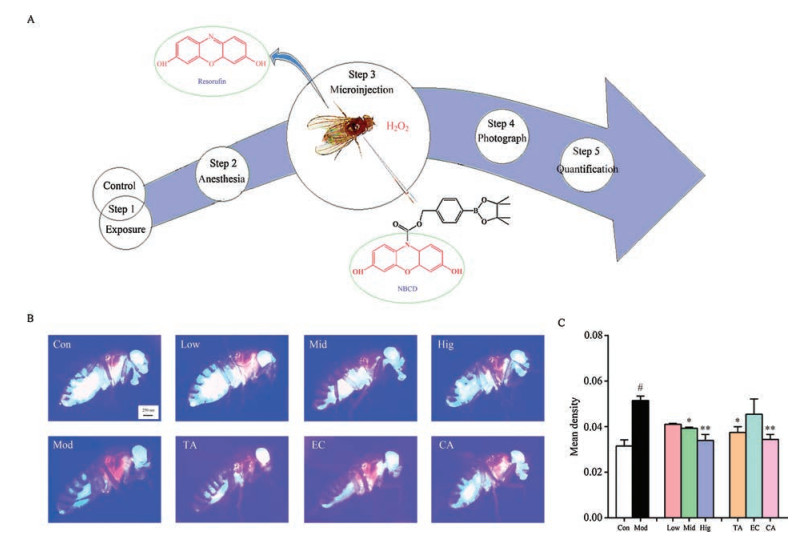
							<p id='82858ab9-488f-476d-a663-d217ac808624'>At last, to measure H<sub>2</sub>O<sub>2</sub> levels in living organisms, it is important to clarify whether a chosen antioxidant actually reacts with a relevant oxidant. A previous study used the mitochondriatargeted ratiometric mass spectrometry probe MitoB to measure mitochondrial H<sub>2</sub>O<sub>2</sub> production in living Drosophila and to determine the proportion of mitochondria in each fly body segment by separating whole flies into their component body segments [<span class="xref"><a href="#b15" ref-type="bibr">15</a></span>]. In this study, NBCD was selective for H<sub>2</sub>O<sub>2</sub> and did not react with other oxidants, and the injection process was not harmful. To derive more insight from the fluorescent images after the experimental procedures shown in <span class="xref"><a href="#Figure4" ref-type="fig">Fig. 4A</a></span>, we tested H<sub>2</sub>O<sub>2</sub>- scavenging activity in living Drosophila, and the results showed that there was a dose-dependent effect. Lees at 2.5 mg/mL and 5.0 mg/mL was sufficient to prevent female flies from damage under oxidative stress conditions. At concentrations of 0.5 mmol/L, tartaric acid and caffeic acid had greater effects on the H<sub>2</sub>O<sub>2</sub> level <i>in vivo</i> than epicatechin (<span class="xref"><a href="#Figure4" ref-type="fig">Figs. 4B</a></span> and <span class="xref"><a href="#Figure4" ref-type="fig">C</a></span>). Epicatechin is known to be a biologically effective antioxidant in wine and tea and contributes to protecting the integrity of endothelial cells not only by scavenging free radicals but also by maintaining NO synthase [<span class="xref"><a href="#b34" ref-type="bibr">34</a></span>, <span class="xref"><a href="#b35" ref-type="bibr">35</a></span>]. In this study, epicatechin supplementation had no significant effect on H<sub>2</sub>O<sub>2</sub> levels in living flies, which suggests that the antioxidant activity of epicatechin mainly manifests in inhibition of NO synthesis rather than removal of HOO<sup>-</sup>. Combined, this outcome indicates that H<sub>2</sub>O<sub>2</sub> in female flies might be modulated by the levels of tartaric acid and caffeic acid included in the experiment as the flies developed.</p>
									<!-- 图段落 -->
						<!-- 表段落 -->
						<!-- box段落 -->
								<!-- 普通段落 -->
									<!-- 图段落 -->
						<h2>Figure 4</h2>
				<div class="_figclass figure">
					<div class="figure_title figure_fulltext clearfix">
																		<a href="/fileHXH/journal/article/ccl/2018/10/PIC/ccl-29-10-1521-4.jpg" title="Figure 4.&nbsp;Outline of the strategy used to assess H2O2 within living flies using NBCD and fluorescent images. (A) The injection process, including the structure of NBCD and its product, Resorufin, which was formed by reaction with H2O2. (B) Fluorescent image 5 min after injection. (C) The average H2O2 level of flies fed diets containing 0 (Con), 1.0 mg/mL (Low), 2.5 mg/mL (Mid) and 5.0 mg/mL (Hig) lees and 0.5 mmol/L of tartaric acid (TA), epicatechin (EC) and caffeic acid (CA). Flies fed basic diets exposed to H2O2 were a model control (Mod). The data are presented as the means ± SD and were analysed by one-way ANOVA (n = 3). #P &lt; 0.001 compared to the control group. *P &lt; 0.05 and **P &lt; 0.01 compared to the model group"  img_id="Fig-Figure4" img_ref="#Fig-Figure4">
							<img style="float:left;display:inline-block;" src="/fileHXH/journal/article/ccl/2018/10/PIC/ccl-29-10-1521-4_mini.jpg" 
								onerror="this.onerror=null;this.src='/fileHXH/journal/article/ccl/2018/10/PIC/ccl-29-10-1521-4.jpg'" 
								class="figure_img" id="Figure4" width="320"/>
						</a>
						<div class="figure_caption">
							<!-- 英文图题 -->
															<div>
									<span class="FigText" id="Figure4">
										<b>Figure 4.</b>&nbsp;
									</span>
									Outline of the strategy used to assess H<sub>2</sub>O<sub>2</sub> within living flies using NBCD and fluorescent images. (A) The injection process, including the structure of NBCD and its product, Resorufin, which was formed by reaction with H<sub>2</sub>O<sub>2</sub>. (B) Fluorescent image 5 min after injection. (C) The average H<sub>2</sub>O<sub>2</sub> level of flies fed diets containing 0 (Con), 1.0 mg/mL (Low), 2.5 mg/mL (Mid) and 5.0 mg/mL (Hig) lees and 0.5 mmol/L of tartaric acid (TA), epicatechin (EC) and caffeic acid (CA). Flies fed basic diets exposed to H<sub>2</sub>O<sub>2</sub> were a model control (Mod). The data are presented as the means ± SD and were analysed by one-way ANOVA (n = 3). <sup>#</sup><i>P</i> &lt; 0.001 compared to the control group. <sup>*</sup><i>P</i> &lt; 0.05 and <sup>**</sup><i>P</i> &lt; 0.01 compared to the model group
								</div>
																					</div>
					</div>
					<!-- 下拉显示 -->
					<div class="figure_button">
						<img src="http://www.ccspublishing.org.cn:80/style/web/images/download.png"/>DownLoad: 
						<a href="javascript:void(0);" onclick="downloadImg('26530678-b30d-4afd-9311-6a2a4ffcd83b','para')">Full-Size Img</a>
						<a href="javascript:void(0);" onclick="downloadPPT('26530678-b30d-4afd-9311-6a2a4ffcd83b','para')" style="border-left: 1px solid #ccc;
    padding-left: 5px;">PowerPoint</a>
					</div>
					<!-- 下拉显示 -->
				</div>
						<!-- 表段落 -->
						<!-- box段落 -->
								<!-- 普通段落 -->
							<p id='e4daa444-7051-46b8-817c-812d10cc4fe4'>In conclusion, the post-column-derived HPLC-UV-FLD system can screen nature antioxidants those rapidly scavenge H<sub>2</sub>O<sub>2</sub> <i>in vitro</i>. Tartaric acid, epicatechin and caffeic acid of lees were revealed by the method. And the robotic manipulation system combined with an NBCD fluorescent probe can be used to show the level of H<sub>2</sub>O<sub>2</sub> in living <i>Drosophila</i>. By using this, H<sub>2</sub>O<sub>2</sub> can be specific selected without the effect of other oxides and peroxidase in vivo. And the "detection online" and "visualization" are realized through microscopic imaging. The result shown that the effect of lees on scavenging H<sub>2</sub>O<sub>2</sub> in living <i>Drosophila</i> was associated with the components caffeic acid and tartaric acid. Taken together, both chemical and biological functions can be detected simultaneously based on the system. And the novel integrated system has great potential for screening and evaluating antioxidants from natural products contribute to the rapid scavenging of H<sub>2</sub>O<sub>2</sub> <i>in vitro</i> and <i>in vivo</i>.</p>
									<!-- 图段落 -->
						<!-- 表段落 -->
						<!-- box段落 -->
							<!-- 输出章节下的段落内容end -->
			<!-- 输出章节标题 start -->
									<h3 class="navTitle">
					<span id="7f536c09-5a89-47f5-9e50-31bf467d0a7c" level="1" sort="2" class="sec-title">
												Acknowledgments
					</span>
				</h3>
							<!-- 输出章节标题 end -->
		<!-- 输出章节下的段落内容start -->
					<!-- 普通段落 -->
							<p id='391f5649-7026-46b0-8aef-ba946597601f'>This work was financially supported by the Collaborative Innovation Center of Research on Functional Ingredients from Agricultural Residues (Guangxi University of Chinese medicine, No. CICAR 2015-B2). The authors appreciate the helpful advice and support from Associate Professor Luqing Shang (College of Pharmacy, Nankai University) on NBCD fluorescent probe.</p>
									<!-- 图段落 -->
						<!-- 表段落 -->
						<!-- box段落 -->
							<!-- 输出章节下的段落内容end -->
			<!-- 输出章节标题 start -->
									<h3 class="navTitle">
					<span id="41ea0e38-fd99-42ae-a976-16c2249c57bf" level="1" sort="3" class="sec-title">
												Appendix A. Supplementary data
					</span>
				</h3>
							<!-- 输出章节标题 end -->
		<!-- 输出章节下的段落内容start -->
					<!-- 普通段落 -->
							<p id='f4acbc36-7913-485f-945c-8aa6e70172e4'>Supplementarymaterial related to this article can befound, in the online version, at doi:<a href="https://doi.org/10.1016/j.cclet.2018.05.020" target="_blank">https://doi.org/10.1016/j.cclet.2018.05.020</a>.</p>
									<!-- 图段落 -->
						<!-- 表段落 -->
						<!-- box段落 -->
							<!-- 输出章节下的段落内容end -->
		<!-- 支持信息 -->
		<!-- 致谢 -->
		</li>
						<!--pdf预览-->
	                    <li id="pdfPreview" class="article-box pdfViewStatus">
	                    	</li>


						<!--参考文献-->
						<li id="References" class="article-box article-references">
							<!-- 所有JSP页面都需要在页面的开始位置包含本页面 -->
<ol>
	<li class="document-box" id="b1">
			<span>
                    [1]
                </span>
			<p>
				T. Ishikawa, S. Tamaki, T. Maruta, S. Shigeoka, Adv. Exp. Med. Biol. 979(2017) 47.<span> doi:  <a class="mainColor ref-doi" href="http://dx.doi.org/10.1007/978-3-319-54910-1" target="_blank">10.1007/978-3-319-54910-1</a></span></p>
		</li>
	<li class="document-box" id="b2">
			<span>
                    [2]
                </span>
			<p>
				M. Schieber, N.S. Chandel, Curr. Biol.:Cb 24(2014) R453-R462.<span> doi:  <a class="mainColor ref-doi" href="http://dx.doi.org/10.1016/j.cub.2014.03.034" target="_blank">10.1016/j.cub.2014.03.034</a></span></p>
		</li>
	<li class="document-box" id="b3">
			<span>
                    [3]
                </span>
			<p>
				X. Liao, Y.A. Liu, Curr. Org. Chem. 17(2013) 654-669.<span> doi:  <a class="mainColor ref-doi" href="http://dx.doi.org/10.2174/1385272811317060008" target="_blank">10.2174/1385272811317060008</a></span></p>
		</li>
	<li class="document-box" id="b4">
			<span>
                    [4]
                </span>
			<p>
				A.A. Karaçelik, M. Küçük, Z. İskefiyeli, et al., Food Chem. 175(2015) 106-114.<span> doi:  <a class="mainColor ref-doi" href="http://dx.doi.org/10.1016/j.foodchem.2014.11.085" target="_blank">10.1016/j.foodchem.2014.11.085</a></span></p>
		</li>
	<li class="document-box" id="b5">
			<span>
                    [5]
                </span>
			<p>
				J. Damašius, P.R. Venskutonis, V. Kaškoniene, A. Maruška, Analyt. Methods 6(2014) 2774-2779.<span> doi:  <a class="mainColor ref-doi" href="http://dx.doi.org/10.1039/c3ay41703d" target="_blank">10.1039/c3ay41703d</a></span></p>
		</li>
	<li class="document-box" id="b6">
			<span>
                    [6]
                </span>
			<p>
				J.D.V.D. Merwe, E. Joubert, M. Manley, et al., Food Chem. Toxicol. 50(2012) 808-815.<span> doi:  <a class="mainColor ref-doi" href="http://dx.doi.org/10.1016/j.fct.2011.11.018" target="_blank">10.1016/j.fct.2011.11.018</a></span></p>
		</li>
	<li class="document-box" id="b7">
			<span>
                    [7]
                </span>
			<p>
				G.G. Guilbault, Anal. Chem. 40(1968) 459R-471R.</p>
		</li>
	<li class="document-box" id="b8">
			<span>
                    [8]
                </span>
			<p>
				B. Qi, Y.Z. Zhu, M. Hu, Y. Zhang, X. Tang, Anal. Lett. 34(2001) 1247-1254.<span> doi:  <a class="mainColor ref-doi" href="http://dx.doi.org/10.1081/AL-100104150" target="_blank">10.1081/AL-100104150</a></span></p>
		</li>
	<li class="document-box" id="b9">
			<span>
                    [9]
                </span>
			<p>
				I. Navarrogonzález, R. Gonzálezbarrio, V. Garcíavalverde, et al., Int. J. Mol. Sci. 16(2014) 805-822.<span> doi:  <a class="mainColor ref-doi" href="http://dx.doi.org/10.3390/ijms16010805" target="_blank">10.3390/ijms16010805</a></span></p>
		</li>
	<li class="document-box" id="b10">
			<span>
                    [10]
                </span>
			<p>
				K.A. Lukyanov, Nat. Methods 3(2006) 281-286.<span> doi:  <a class="mainColor ref-doi" href="http://dx.doi.org/10.1038/nmeth866" target="_blank">10.1038/nmeth866</a></span></p>
		</li>
	<li class="document-box" id="b11">
			<span>
                    [11]
                </span>
			<p>
				M. Gutscher, M.C. Sobotta, G.H. Wabnitz, et al., J. Biol. Chem. 284(2009) 31532.<span> doi:  <a class="mainColor ref-doi" href="http://dx.doi.org/10.1074/jbc.M109.059246" target="_blank">10.1074/jbc.M109.059246</a></span></p>
		</li>
	<li class="document-box" id="b12">
			<span>
                    [12]
                </span>
			<p>
				K.N. Markvicheva, D.S. Bilan, N.M. Mishina, et al., Biorg. Med. Chem. 19(2011) 1079-1084.<span> doi:  <a class="mainColor ref-doi" href="http://dx.doi.org/10.1016/j.bmc.2010.07.014" target="_blank">10.1016/j.bmc.2010.07.014</a></span></p>
		</li>
	<li class="document-box" id="b13">
			<span>
                    [13]
                </span>
			<p>
				D.S. Bilan, L. Pase, L. Joosen, et al., ACS Chem. Biol. 8(2013) 535-542.<span> doi:  <a class="mainColor ref-doi" href="http://dx.doi.org/10.1021/cb300625g" target="_blank">10.1021/cb300625g</a></span></p>
		</li>
	<li class="document-box" id="b14">
			<span>
                    [14]
                </span>
			<p>
				K. Liu, H. Shang, X. Kong, et al., Biomaterials 100(2016) 162.<span> doi:  <a class="mainColor ref-doi" href="http://dx.doi.org/10.1016/j.biomaterials.2016.05.029" target="_blank">10.1016/j.biomaterials.2016.05.029</a></span></p>
		</li>
	<li class="document-box" id="b15">
			<span>
                    [15]
                </span>
			<p>
				H.M. Cochemé, A. Logan, T.A. Prime, et al., Nat. Protoc. 7(2012) 946-958.<span> doi:  <a class="mainColor ref-doi" href="http://dx.doi.org/10.1038/nprot.2012.035" target="_blank">10.1038/nprot.2012.035</a></span></p>
		</li>
	<li class="document-box" id="b16">
			<span>
                    [16]
                </span>
			<p>
				Z. Han, X. Liang, X. Ren, L. Shang, Z. Yin, Chem-Asian J. 11(2016) 818-822.<span> doi:  <a class="mainColor ref-doi" href="http://dx.doi.org/10.1002/asia.v11.6" target="_blank">10.1002/asia.v11.6</a></span></p>
		</li>
	<li class="document-box" id="b17">
			<span>
                    [17]
                </span>
			<p>
				Y.X. Zou, M.H. Ruan, J. Luan, et al., J. Nutr. Health Aging 21(2016) 1-6. <a class="mainColor ref-url" href="https://www.ncbi.nlm.nih.gov/pubmed/27878417" target="_blank">https://www.ncbi.nlm.nih.gov/pubmed/27878417</a></p>
		</li>
	<li class="document-box" id="b18">
			<span>
                    [18]
                </span>
			<p>
				L.M. De Aguiar, F.H. Figueira, M.S. Gottschalk, R.C. Da, Comp. Biochem. Phys. C 185-186(2016) 94-101.</p>
		</li>
	<li class="document-box" id="b19">
			<span>
                    [19]
                </span>
			<p>
				P.B. Bagatini, L. Saur, M.F. Rodrigues, et al., Invert. Neurosci. 11(2011) 43.<span> doi:  <a class="mainColor ref-doi" href="http://dx.doi.org/10.1007/s10158-011-0116-3" target="_blank">10.1007/s10158-011-0116-3</a></span></p>
		</li>
	<li class="document-box" id="b20">
			<span>
                    [20]
                </span>
			<p>
				X. Sun, T. Komatsu, J. Lim, et al., Aging Cell. 11(2012) 783-793.<span> doi:  <a class="mainColor ref-doi" href="http://dx.doi.org/10.1111/j.1474-9726.2012.00842.x" target="_blank">10.1111/j.1474-9726.2012.00842.x</a></span></p>
		</li>
	<li class="document-box" id="b21">
			<span>
                    [21]
                </span>
			<p>
				C. Peng, H.Y. Chan, Y. Huang, H. Yu, Z.Y. Chen, J. Agric. Food Chem. 59(2011) 2097-2106.<span> doi:  <a class="mainColor ref-doi" href="http://dx.doi.org/10.1021/jf1046267" target="_blank">10.1021/jf1046267</a></span></p>
		</li>
	<li class="document-box" id="b22">
			<span>
                    [22]
                </span>
			<p>
				J. Dasgupta, S. Subbaram, K.M. Connor, et al., Antioxid. Redox Signal. 8(2006) 1295-1305.<span> doi:  <a class="mainColor ref-doi" href="http://dx.doi.org/10.1089/ars.2006.8.1295" target="_blank">10.1089/ars.2006.8.1295</a></span></p>
		</li>
	<li class="document-box" id="b23">
			<span>
                    [23]
                </span>
			<p>
				G. Patro, S.K. Bhattamisra, B.K. Mohanty, H.B. Sahoo, Pharm. Res. 8(2016) 22.</p>
		</li>
	<li class="document-box" id="b24">
			<span>
                    [24]
                </span>
			<p>
				M.V. Baroni, R.D.D.P. Naranjo, C. García-Ferreyra, S. Otaiza, D.A. Wunderlin, LWT Food Sci. Technol. 47(2012) 1-7.<span> doi:  <a class="mainColor ref-doi" href="http://dx.doi.org/10.1016/j.lwt.2012.01.015" target="_blank">10.1016/j.lwt.2012.01.015</a></span></p>
		</li>
	<li class="document-box" id="b25">
			<span>
                    [25]
                </span>
			<p>
				E. Kurin, P. Mučaji, M. Nagy, Molecules 17(2012) 143369-14348.</p>
		</li>
	<li class="document-box" id="b26">
			<span>
                    [26]
                </span>
			<p>
				Y. Niu, L. Yin, S. Luo, et al., Phytochem. Anal. 24(2013) 59-68.<span> doi:  <a class="mainColor ref-doi" href="http://dx.doi.org/10.1002/pca.v24.1" target="_blank">10.1002/pca.v24.1</a></span></p>
		</li>
	<li class="document-box" id="b27">
			<span>
                    [27]
                </span>
			<p>
				J.Hong, J.Maguhn, D.Freitag, A.Kettrup, FreseniusJ.Anal.Chem.361(1998)124-128.<span> doi:  <a class="mainColor ref-doi" href="http://dx.doi.org/10.1007/s002160050847" target="_blank">10.1007/s002160050847</a></span></p>
		</li>
	<li class="document-box" id="b28">
			<span>
                    [28]
                </span>
			<p>
				N. Li, Y. Liu, S. Li, et al., Mod. Phys. Lett. B 31(2017) 1750148.<span> doi:  <a class="mainColor ref-doi" href="http://dx.doi.org/10.1134/S1063776107120047" target="_blank">10.1134/S1063776107120047</a></span></p>
		</li>
	<li class="document-box" id="b29">
			<span>
                    [29]
                </span>
			<p>
				Z. Sroka, W. Cisowski, Food Chem. Toxicol. 41(2003) 753-758.<span> doi:  <a class="mainColor ref-doi" href="http://dx.doi.org/10.1016/S0278-6915(02)00329-0" target="_blank">10.1016/S0278-6915(02)00329-0</a></span></p>
		</li>
	<li class="document-box" id="b30">
			<span>
                    [30]
                </span>
			<p>
				S.Z. Gorjanović, M.M. Novaković, N.I. Potkonjak, D.Z. Suznjević, J. Agric. Food Chem. 58(2010) 4626.<span> doi:  <a class="mainColor ref-doi" href="http://dx.doi.org/10.1021/jf100022e" target="_blank">10.1021/jf100022e</a></span></p>
		</li>
	<li class="document-box" id="b31">
			<span>
                    [31]
                </span>
			<p>
				A.V. Peskin, A.G. Cox, P. Nagy, et al., Biochem. J. 432(2010) 313-321.<span> doi:  <a class="mainColor ref-doi" href="http://dx.doi.org/10.1042/BJ20101156" target="_blank">10.1042/BJ20101156</a></span></p>
		</li>
	<li class="document-box" id="b32">
			<span>
                    [32]
                </span>
			<p>
				N.E. Gislason, B.L. Currie, A.L. Waterhouse, J. Agric. Food Chem. 59(2011) 6221-6226.<span> doi:  <a class="mainColor ref-doi" href="http://dx.doi.org/10.1021/jf200115y" target="_blank">10.1021/jf200115y</a></span></p>
		</li>
	<li class="document-box" id="b33">
			<span>
                    [33]
                </span>
			<p>
				M. Wołonciej, E. Milewska, W. Roszkowska-Jakimiec, Postepy. Hig. Med. Dosw. 70(2016) 1483.<span> doi:  <a class="mainColor ref-doi" href="http://dx.doi.org/10.5604/17322693.1229074" target="_blank">10.5604/17322693.1229074</a></span></p>
		</li>
	<li class="document-box" id="b34">
			<span>
                    [34]
                </span>
			<p>
				M.M. Cals-Grierson, Patent, WO0182929, 2001.</p>
		</li>
	<li class="document-box" id="b35">
			<span>
                    [35]
                </span>
			<p>
				Y. Steffen, T. Schewe, H. Sies, Biochem. Biophys. Res. Commun. 331(2005) 1277-1283.<span> doi:  <a class="mainColor ref-doi" href="http://dx.doi.org/10.1016/j.bbrc.2005.04.035" target="_blank">10.1016/j.bbrc.2005.04.035</a></span></p>
		</li>
	</ol></li>
						
	
						<!--相关文章-->
						<li class="article-box relateArticleStatus article-related-article" id="relative-article">
							</li>
	
						<!--图表-->
						<!--Figure/Table-->
						<li class="article-box article-chart" id="figTab">
							<!-- 所有JSP页面都需要在页面的开始位置包含本页面 -->
<!DOCTYPE html PUBLIC "-//W3C//DTD XHTML 1.0 Transitional//EN" "http://www.w3.org/TR/xhtml1/DTD/xhtml1-transitional.dtd">
<html>
<head>
    <meta name="renderer" content="webkit" />
    <meta http-equiv="X-UA-Compatible" content="IE=edge" />
</head>
<body>
<div class="_figclass figure">
            <div class="figureTextBox">
                <div>
                    <a class="" title="Antioxidant protection of lees against paraquat and hydrogen peroxide oxidative stress. Paraquat assay: (A) Females, P &lt; 0.01, 1.0 mg/mL lees vs. Control; P &lt; 0.001, 2.5 mg/mL lees vs. Control. (B) Males, P &lt; 0.01, 1.0 mg/mL lees vs. Control; P &lt; 0.001, 2.5 mg/mL lees vs. Control; P &lt; 0.001, 5.0 mg/mL lees vs. Control. (C) Mean lifespan. Both female and male flies fed the 2.5 mg/mL lees-treated food exhibited a significant increase in survival after exposure to paraquat. Hydrogen peroxide assay: (D) Females, P &lt; 0.05, 1.0 mg/mL lees vs. Control; P &lt; 0.001, 2.5 mg/mL lees vs. Control. (E) Males. (F) Mean lifespan: Male flies on lees-treated food did not exhibit a significant increase in survival when exposed to hydrogen peroxide. *P &lt; 0.05, **P &lt; 0.01, and ***P &lt; 0.001. Significant differences between the curves were analysed by log-rank test. Data are presented as the means ± SD, and differences compared to the control were considered significant at *P &lt; 0.05, **P &lt; 0.01 and ***P &lt; 0.001 according to one-way ANOVA" href="http://ccspublishing.org.cn:80/journal/article/ccl/2018/10/PIC/ccl-29-10-1521-1.jpg" >
								<img src="/fileHXH/journal/article/ccl/2018/10/PIC/ccl-29-10-1521-1_mini.jpg" 
									onerror="this.onerror=null;this.src='/fileHXH/journal/article/ccl/2018/10/PIC/ccl-29-10-1521-1.jpg'" 
									class="figure_img" 
									id="Fig-Figure1" ref="#Fig-Figure1"/>
							</a>
						</div>
                <div class="figureTitle">
               		<!-- 英文图题 -->
                    <p class="figTabSpan">
							<span class="FigText" id="Figure1">
								<b>Figure 1</b>&nbsp;
							</span>
							Antioxidant protection of lees against paraquat and hydrogen peroxide oxidative stress. Paraquat assay: (A) Females, <i>P</i> &lt; 0.01, 1.0 mg/mL lees <i>vs</i>. Control; <i>P</i> &lt; 0.001, 2.5 mg/mL lees <i>vs</i>. Control. (B) Males, <i>P</i> &lt; 0.01, 1.0 mg/mL lees <i>vs</i>. Control; <i>P</i> &lt; 0.001, 2.5 mg/mL lees <i>vs</i>. Control; <i>P</i> &lt; 0.001, 5.0 mg/mL lees <i>vs</i>. Control. (C) Mean lifespan. Both female and male flies fed the 2.5 mg/mL lees-treated food exhibited a significant increase in survival after exposure to paraquat. Hydrogen peroxide assay: (D) Females, 
<i>P</i> &lt; 0.05, 1.0 mg/mL lees <i>vs</i>. Control; <i>P</i> &lt; 0.001, 2.5 mg/mL lees <i>vs</i>. Control. (E) Males. (F) Mean lifespan: Male flies on lees-treated food did not exhibit a significant increase in survival when exposed to hydrogen peroxide. <sup>*</sup><i>P</i> &lt; 0.05, <sup>**</sup><i>P</i> &lt; 0.01, and <sup>***</sup><i>P</i> &lt; 0.001. Significant differences between the curves were analysed by log-rank test. Data are presented as the means ± SD, and differences compared to the control were considered significant at <sup>*</sup><i>P</i> &lt; 0.05, <sup>**</sup><i>P</i> &lt; 0.01 and <sup>***</sup><i>P</i> &lt; 0.001 according to one-way ANOVA</p>
                    <!-- 中文图注 -->
                    <!-- 英文图注 -->
                    </div>
            </div>
            <!-- 下拉显示 -->
			<div class="figure_button">
				<img src="http://ccspublishing.org.cn:80/style/web/images/article/download.png"/>下载: 
				<a href="javascript:void(0);" onclick="downloadImg('12ae369a-722c-4de2-b671-20edb7715e30','figure')">全尺寸图片</a>
				<a href="javascript:void(0);" onclick="downloadPPT('12ae369a-722c-4de2-b671-20edb7715e30','figure')" style="border-left: 1px solid #ccc;padding-left: 5px;">幻灯片</a>						
			</div>
			<!-- 下拉显示 -->		
        </div>
    <div class="_figclass figure">
            <div class="figureTextBox">
                <div>
                    <a class="" title="Eff ects of less supplementation (2.5 mg/mL diet) on enzymatic activity and protein expression compared to the control diet. Enzyme activity: (A) SOD1. (B) SOD2. (C) CAT; Gene expression: (D) SOD1. (E) SOD2. (F) CAT. The band intensity was quantified by scanning densitometry and standardized with respect to β-actin. The data are shown as the mean ± SD and were analysed by one-way ANOVA. *P &lt; 0.05, **P &lt; 0.01 and ***P &lt; 0.001 compared to the control group" href="http://ccspublishing.org.cn:80/journal/article/ccl/2018/10/PIC/ccl-29-10-1521-2.jpg" >
								<img src="/fileHXH/journal/article/ccl/2018/10/PIC/ccl-29-10-1521-2_mini.jpg" 
									onerror="this.onerror=null;this.src='/fileHXH/journal/article/ccl/2018/10/PIC/ccl-29-10-1521-2.jpg'" 
									class="figure_img" 
									id="Fig-Figure2" ref="#Fig-Figure2"/>
							</a>
						</div>
                <div class="figureTitle">
               		<!-- 英文图题 -->
                    <p class="figTabSpan">
							<span class="FigText" id="Figure2">
								<b>Figure 2</b>&nbsp;
							</span>
							Eff ects of less supplementation (2.5 mg/mL diet) on enzymatic activity and protein expression compared to the control diet. Enzyme activity: (A) SOD1. (B) SOD2. (C) CAT; Gene expression: (D) SOD1. (E) SOD2. (F) CAT. The band intensity was quantified by scanning densitometry and standardized with respect to <i>β</i>-actin. The data are shown as the mean ± SD and were analysed by one-way ANOVA. <sup>*</sup><i>P</i> &lt; 0.05, <sup>**</sup><i>P</i> &lt; 0.01 and <sup>***</sup><i>P</i> &lt; 0.001 compared to the control group</p>
                    <!-- 中文图注 -->
                    <!-- 英文图注 -->
                    </div>
            </div>
            <!-- 下拉显示 -->
			<div class="figure_button">
				<img src="http://ccspublishing.org.cn:80/style/web/images/article/download.png"/>下载: 
				<a href="javascript:void(0);" onclick="downloadImg('85e01207-8c00-4ea6-bf55-561cdd9955a2','figure')">全尺寸图片</a>
				<a href="javascript:void(0);" onclick="downloadPPT('85e01207-8c00-4ea6-bf55-561cdd9955a2','figure')" style="border-left: 1px solid #ccc;padding-left: 5px;">幻灯片</a>						
			</div>
			<!-- 下拉显示 -->		
        </div>
    <div class="_figclass figure">
            <div class="figureTextBox">
                <div>
                    <a class="" title="HPLC-UV-FLD chromatogram of the sample extracted from lees and mixed standards of caffeic acid, tartaric acid, gallic acid, L-epicatechin and quercetin. a: HPLC-UV chromatogram of the sample extracted from lees; b: HPLC-FLD chromatogram of the sample extracted from lees. c: HPLC-UV chromatogram of mixed standards; d: HPLC-FLD chromatogram of mixed standards. Peaks and structures: 1, caffeic acid; 2, tartaric acid; 3, Gallic acid; 4, L-Epicatechin; 5, Quercetin" href="http://ccspublishing.org.cn:80/journal/article/ccl/2018/10/PIC/ccl-29-10-1521-3.jpg" >
								<img src="/fileHXH/journal/article/ccl/2018/10/PIC/ccl-29-10-1521-3_mini.jpg" 
									onerror="this.onerror=null;this.src='/fileHXH/journal/article/ccl/2018/10/PIC/ccl-29-10-1521-3.jpg'" 
									class="figure_img" 
									id="Fig-Figure3" ref="#Fig-Figure3"/>
							</a>
						</div>
                <div class="figureTitle">
               		<!-- 英文图题 -->
                    <p class="figTabSpan">
							<span class="FigText" id="Figure3">
								<b>Figure 3</b>&nbsp;
							</span>
							HPLC-UV-FLD chromatogram of the sample extracted from lees and mixed standards of caffeic acid, tartaric acid, gallic acid, <sub>L</sub>-epicatechin and quercetin. a: HPLC-UV chromatogram of the sample extracted from lees; b: HPLC-FLD chromatogram of the sample extracted from lees. c: HPLC-UV chromatogram of mixed standards; d: HPLC-FLD chromatogram of mixed standards. Peaks and structures: 1, caffeic acid; 2, tartaric acid; 3, Gallic acid; 4, <sub>L</sub>-Epicatechin; 5, Quercetin</p>
                    <!-- 中文图注 -->
                    <!-- 英文图注 -->
                    </div>
            </div>
            <!-- 下拉显示 -->
			<div class="figure_button">
				<img src="http://ccspublishing.org.cn:80/style/web/images/article/download.png"/>下载: 
				<a href="javascript:void(0);" onclick="downloadImg('5ef3d614-efc7-4ee5-a43c-b1849c676b7e','figure')">全尺寸图片</a>
				<a href="javascript:void(0);" onclick="downloadPPT('5ef3d614-efc7-4ee5-a43c-b1849c676b7e','figure')" style="border-left: 1px solid #ccc;padding-left: 5px;">幻灯片</a>						
			</div>
			<!-- 下拉显示 -->		
        </div>
    <div class="_figclass figure">
            <div class="figureTextBox">
                <div>
                    <a class="" title="Outline of the strategy used to assess H2O2 within living flies using NBCD and fluorescent images. (A) The injection process, including the structure of NBCD and its product, Resorufin, which was formed by reaction with H2O2. (B) Fluorescent image 5 min after injection. (C) The average H2O2 level of flies fed diets containing 0 (Con), 1.0 mg/mL (Low), 2.5 mg/mL (Mid) and 5.0 mg/mL (Hig) lees and 0.5 mmol/L of tartaric acid (TA), epicatechin (EC) and caffeic acid (CA). Flies fed basic diets exposed to H2O2 were a model control (Mod). The data are presented as the means ± SD and were analysed by one-way ANOVA (n = 3). #P &lt; 0.001 compared to the control group. *P &lt; 0.05 and **P &lt; 0.01 compared to the model group" href="http://ccspublishing.org.cn:80/journal/article/ccl/2018/10/PIC/ccl-29-10-1521-4.jpg" >
								<img src="/fileHXH/journal/article/ccl/2018/10/PIC/ccl-29-10-1521-4_mini.jpg" 
									onerror="this.onerror=null;this.src='/fileHXH/journal/article/ccl/2018/10/PIC/ccl-29-10-1521-4.jpg'" 
									class="figure_img" 
									id="Fig-Figure4" ref="#Fig-Figure4"/>
							</a>
						</div>
                <div class="figureTitle">
               		<!-- 英文图题 -->
                    <p class="figTabSpan">
							<span class="FigText" id="Figure4">
								<b>Figure 4</b>&nbsp;
							</span>
							Outline of the strategy used to assess H<sub>2</sub>O<sub>2</sub> within living flies using NBCD and fluorescent images. (A) The injection process, including the structure of NBCD and its product, Resorufin, which was formed by reaction with H<sub>2</sub>O<sub>2</sub>. (B) Fluorescent image 5 min after injection. (C) The average H<sub>2</sub>O<sub>2</sub> level of flies fed diets containing 0 (Con), 1.0 mg/mL (Low), 2.5 mg/mL (Mid) and 5.0 mg/mL (Hig) lees and 0.5 mmol/L of tartaric acid (TA), epicatechin (EC) and caffeic acid (CA). Flies fed basic diets exposed to H<sub>2</sub>O<sub>2</sub> were a model control (Mod). The data are presented as the means ± SD and were analysed by one-way ANOVA (n = 3). <sup>#</sup><i>P</i> &lt; 0.001 compared to the control group. <sup>*</sup><i>P</i> &lt; 0.05 and <sup>**</sup><i>P</i> &lt; 0.01 compared to the model group</p>
                    <!-- 中文图注 -->
                    <!-- 英文图注 -->
                    </div>
            </div>
            <!-- 下拉显示 -->
			<div class="figure_button">
				<img src="http://ccspublishing.org.cn:80/style/web/images/article/download.png"/>下载: 
				<a href="javascript:void(0);" onclick="downloadImg('1e7a5903-111a-44ab-9c02-e1175e432aa4','figure')">全尺寸图片</a>
				<a href="javascript:void(0);" onclick="downloadPPT('1e7a5903-111a-44ab-9c02-e1175e432aa4','figure')" style="border-left: 1px solid #ccc;padding-left: 5px;">幻灯片</a>						
			</div>
			<!-- 下拉显示 -->		
        </div>
    </body>
</html>
</li>
						
	
						<!--知识图谱-->
						<li id="map" class="article-box article-knowledge-map"></li>
		            	<!--Supplementary 附件-->
						<li id="Supplementary" class="article-box article-box6 article-annex">
							</li>
						
	
						<!--访问统计  可显示-->
						<li class="article-box visitStatisticsStatus article-statistics" id="metric_count">
							<!-- loading -->
							<img id="downLoading" src="http://ccspublishing.org.cn:80/style/web/images/1.gif" alt="加载中" />
							<div class="hichart_box" id="article_visit_count_column"></div>
							<div class="hichart_box" id="article_visit_type_pie"></div>
							<div class="hichart_box" id="article_visit_area_pie"></div>
						</li>


					</ul>
			</div>

    <!-- 化学会 ccs展示 -->
    <div class="article-right pull-right album-div" style="display:none;">
               <div style="text-align:center;"><a href ="http://ccspublishing.org.cn:80/topic/specialArticles?tab=liangdianpingshu" style="color:#0178d6; font-size:18px;">亮点评述</a></div>
		   	   <ul class="album-content">
		            <li>
		                    <span class="pull-left mainBg"></span>
		                    <div class="">
		                        <a class="caption mainColor" href="http://ccspublishing.org.cn:80/article/doi/10.31635/ccschem.020.202000238">CCS Chemistry：POSS树枝状聚合物自组装：刚柔相济、始可有成</a>
		                       <div class="author">
		                            </div>
		                        <p class="textHidden"><a class="mainHoverColor" href="http://ccspublishing.org.cn:80/journal/">CCS Chemistry</a>, 2020, 2(0):
			                        1093-1104.
					                <!--<a href="article/doi/10.31635/ccschem.020.202000238">doi:10.31635/ccschem.020.202000238</a>
				                    -->
				                </p>
		                    </div>
		                </li>
		               <li>
		                    <span class="pull-left mainBg"></span>
		                    <div class="">
		                        <a class="caption mainColor" href="http://ccspublishing.org.cn:80/article/doi/10.31635/ccschem.020.202000297"><h2 class="rich_media_title" id="activity-name" style="margin: 0px 0px 14px; padding: 0px; line-height: 1.4;"><span style="font-weight: normal;">CCS Chemistry：嵌段共聚物自组装成 “三明治”二维有机材料，实现纳米级压力传感功能</span><br /></h2></a>
		                       <div class="author">
		                            </div>
		                        <p class="textHidden"><a class="mainHoverColor" href="http://ccspublishing.org.cn:80/journal/">CCS Chemistry</a>, 2020, 2(0):
			                        1399-1409.
					                <!--<a href="article/doi/10.31635/ccschem.020.202000297">doi:10.31635/ccschem.020.202000297</a>
				                    -->
				                </p>
		                    </div>
		                </li>
		               <li>
		                    <span class="pull-left mainBg"></span>
		                    <div class="">
		                        <a class="caption mainColor" href="http://ccspublishing.org.cn:80/article/doi/10.31635/ccschem.019.20190048"><h2 class="rich_media_title" id="activity-name" style="margin: 0px 0px 14px; padding: 0px; line-height: 1.4;"><span style="font-weight: normal;"><span style="font-size:16px;">CCS Chemistry：颜徐州、鲍哲南： 你的皮肤可能是一片SPMs</span></span></h2></a>
		                       <div class="author">
		                            </div>
		                        <p class="textHidden"><a class="mainHoverColor" href="http://ccspublishing.org.cn:80/journal/">CCS Chemistry</a>, 2019, 1(4):
			                        431-447.
					                <!--<a href="article/doi/10.31635/ccschem.019.20190048">doi:10.31635/ccschem.019.20190048</a>
				                    -->
				                </p>
		                    </div>
		                </li>
		               <li>
		                    <span class="pull-left mainBg"></span>
		                    <div class="">
		                        <a class="caption mainColor" href="http://ccspublishing.org.cn:80/article/doi/"><strong><span style="font-family:微软雅黑;font-size:12pt;"><span style="font-family:微软雅黑;">CCS Chemistry | 国家自然科学基金委员会高飞雪</span><span style="font-family:微软雅黑;">&amp;杨俊林</span><span style="font-family:微软雅黑;">：国家自然科学基金化学基础研究的资助策略、趋势与前沿</span></span></strong></a>
		                       <div class="author">
		                            </div>
		                        <p class="textHidden"><a class="mainHoverColor" href="http://ccspublishing.org.cn:80/journal/">CCS Chemistry</a>, 2025, 7(10.31635/ccschem.025.202405124):
			                        -.
					                <!---->
				                </p>
		                    </div>
		                </li>
		               <li>
		                    <span class="pull-left mainBg"></span>
		                    <div class="">
		                        <a class="caption mainColor" href="http://ccspublishing.org.cn:80/article/doi/10.31635/ccschem.020.201900065"><h2 style="text-align: left; margin: 0px 0px 14px; padding: 0px; line-height: 1.4;">CCS Chemistry：工作高效不疲劳，只须让催化剂动起来</h2></a>
		                       <div class="author">
		                            </div>
		                        <p class="textHidden"><a class="mainHoverColor" href="http://ccspublishing.org.cn:80/journal/">CCS Chemistry</a>, 2020, 2(1):
			                        31-41.
					                <!--<a href="article/doi/10.31635/ccschem.020.201900065">doi:10.31635/ccschem.020.201900065</a>
				                    -->
				                </p>
		                    </div>
		                </li>
		               <li>
		                    <span class="pull-left mainBg"></span>
		                    <div class="">
		                        <a class="caption mainColor" href="http://ccspublishing.org.cn:80/article/doi/"><p style="text-align:center;">CCS Chemistry |&nbsp;<span style=" font-family: 微软雅黑; font-size: 12pt;"><strong>超分子活化底物</strong></span><span style=" font-family: 微软雅黑; font-size: 12pt;"><strong>为</strong></span><span style=" font-family: 微软雅黑; font-size: 12pt;"><strong>自由基</strong></span><span style=" font-family: 微软雅黑; font-size: 12pt;"><strong>促进高效</strong></span><span style=" font-family: 微软雅黑; font-size: 12pt;"><strong>选择性光</strong></span><span style=" font-family: 微软雅黑; font-size: 12pt;"><strong>催化</strong></span><span style=" font-family: 微软雅黑; font-size: 12pt;"><strong>氧化</strong></span></p><br /></a>
		                       <div class="author">
		                            </div>
		                        <p class="textHidden"><a class="mainHoverColor" href="http://ccspublishing.org.cn:80/journal/">CCS Chemistry</a>, 2025, 7(10.31635/ccschem.025.202405229):
			                        -.
					                <!---->
				                </p>
		                    </div>
		                </li>
		               <li>
		                    <span class="pull-left mainBg"></span>
		                    <div class="">
		                        <a class="caption mainColor" href="http://ccspublishing.org.cn:80/article/doi/10.31635/ccschem.020.202000354"><h2 class="rich_media_title" id="activity-name" style="margin: 0px 0px 14px; padding: 0px; line-height: 1.4;"><span style="font-weight: normal;">CCS Chemistry：静电组装导向聚合- 聚电解质纳米凝胶量化制备新策略</span></h2></a>
		                       <div class="author">
		                            </div>
		                        <p class="textHidden"><a class="mainHoverColor" href="http://ccspublishing.org.cn:80/journal/">CCS Chemistry</a>, 2020, 2(0):
			                        1016-1025.
					                <!--<a href="article/doi/10.31635/ccschem.020.202000354">doi:10.31635/ccschem.020.202000354</a>
				                    -->
				                </p>
		                    </div>
		                </li>
		               <li>
		                    <span class="pull-left mainBg"></span>
		                    <div class="">
		                        <a class="caption mainColor" href="http://ccspublishing.org.cn:80/article/doi/"><p style="text-align:center;"><strong><span style="font-family:微软雅黑;font-size:12pt;"><span style="font-family:微软雅黑;">CCS Chemistry 综述推荐</span><span style="font-family:微软雅黑;">│绿色氧化新</span></span><span style="font-family:微软雅黑;font-size:12pt;">思路</span><span style="font-family:微软雅黑;font-size:12pt;"><span style="font-family:微软雅黑;">：光</span>/电催化助力有机物高效升级</span></strong></p></a>
		                       <div class="author">
		                            </div>
		                        <p class="textHidden"><a class="mainHoverColor" href="http://ccspublishing.org.cn:80/journal/">CCS Chemistry</a>, 2025, 7(10.31635/ccschem.024.202405369):
			                        -.
					                <!---->
				                </p>
		                    </div>
		                </li>
		               <li>
		                    <span class="pull-left mainBg"></span>
		                    <div class="">
		                        <a class="caption mainColor" href="http://ccspublishing.org.cn:80/article/doi/10.31635/ccschem.020.202000227"><p style=""><span style="font-size:16px;">CCS Chemistry：科学新发现：二芳基乙烯-卓越的单光子吸收上转换发光材料</span></p></a>
		                       <div class="author">
		                            </div>
		                        <p class="textHidden"><a class="mainHoverColor" href="http://ccspublishing.org.cn:80/journal/">CCS Chemistry</a>, 2020, 2(0):
			                        665-674.
					                <!--<a href="article/doi/10.31635/ccschem.020.202000227">doi:10.31635/ccschem.020.202000227</a>
				                    -->
				                </p>
		                    </div>
		                </li>
		               <li>
		                    <span class="pull-left mainBg"></span>
		                    <div class="">
		                        <a class="caption mainColor" href="http://ccspublishing.org.cn:80/article/doi/10.31635/ccschem.020.202000219"><h2 class="rich_media_title" id="activity-name" style="margin: 0px 0px 14px; padding: 0px; line-height: 1.4;"><span style="font-family: SimSun; font-size: 16px;">CCS Chemistry：金黄色葡萄球菌醛基脱氢酶是如何识别特异性底物的？</span></h2></a>
		                       <div class="author">
		                            </div>
		                        <p class="textHidden"><a class="mainHoverColor" href="http://ccspublishing.org.cn:80/journal/">CCS Chemistry</a>, 2020, 2(0):
			                        946-954.
					                <!--<a href="article/doi/10.31635/ccschem.020.202000219">doi:10.31635/ccschem.020.202000219</a>
				                    -->
				                </p>
		                    </div>
		                </li>
		               </ul>
		 
   
    </div>
    <!-- 化学会ccs展示 -->
			<!--右侧内容-->
			<div class="article-right pull-right" >

				<!--下载模块及二维码-->
				<div class="download">
					<div class="btns pull-left">
						<button class="btn pdf-btn" onclick="downloadpdf('a9d994e9-6945-48d1-8a86-cf5368c525af');">
							<span class="articleFont icon-pdf pull-left" style="line-height:35px;font-size:25px;padding-right:5px;"></span>
							<a href="javascript:void(0);" class="download-font pull-left">PDF下载
								<b id="pdfSize" style="font-size:12px;">( 976 KB)</b></a>
						</button>
						<button class="btn xml-btn littleBtn"
							onclick="toExportXML('a9d994e9-6945-48d1-8a86-cf5368c525af');">
							<a href="javascript:void(0);" class="download-font">XML下载</a>
						</button>
						<button class="btn li-excel littleBtn" data-target="#exportCitationModal"
							data-toggle="modal">
							<a class="download-font" href="javascript:void(0);">导出引用</a>
						</button>
					</div>
					<div class="Matrix-code pull-right">
						<img id="weChatOne" style="display:block;" src="http://ccspublishing.org.cn:80/style/web/images/WeChat.png" alt="WeChat">
						<span>扫一扫看文章</span>
					</div>
					
				</div>

				<!--图集-->
				<!--计量-->
				<div class="met right-border">
					<h5>
						<b>计量</b><span class="articleFont icon-jiliangdian pull-right"></span>
					</h5>
					<div class="line-img"></div>
					<ul>
						<li><b>PDF下载量:&nbsp;</b><span id="downloadArticleCount" class="mainColor">
							2</span></li>
						<li><b>文章访问数:&nbsp;</b><span id="visitArticleCount" class="mainColor">
							2032</span></li>
						<li><b>HTML全文浏览量:&nbsp;</b><span id="htmlViewCount" class="mainColor">
						116</span></li>
					    <!--<li><b>被引次数:&nbsp;</b><span id="citeCount" class="mainColor"></span></li>-->
					</ul>
				</div>

				<!--文章相关-->
				<div class="article-related right-border">
					<h5><b>文章相关</b></h5>
					<div class="line-img"></div>
					<ul>
						<!--<li><b>通讯作者:&nbsp;</b><span id=""> Yuanyuan Hou, <a
												class="mainColor" href="mailto:houyy@nankai.edu.cn">houyy@nankai.edu.cn</a>
											</span>
										<span id=""> Hongjun Wei, <a
												class="mainColor" href="mailto:weihongjun@188.com">weihongjun@188.com</a>
											</span>
										</li>
							-->
						<li><b>发布日期:&nbsp;</b><span id="" class="mainColor">
								2018-10-22</span>
							</li>
						<li><b>收稿日期:&nbsp;</b><span id="" class="mainColor">
								2018-03-27</span>
							</li>
						<li><b>接受日期:&nbsp;</b><span id="" class="mainColor">
								2018-05-07</span>
							</li>
						<li><b>修回日期:&nbsp;</b><span id="" class="mainColor">
	    					   2018-05-04</span>
	    					   </li>
	    				<li><b>网络出版日期:&nbsp;</b><span id="" class="mainColor">
								2018-10-09</span>
							</li>
						</ul>
				</div>
				<!--全文导航-->
				<div id="navigation">
					<div class="nav-nav">
						<div class="last-page">
							<span></span>
						</div>
						<div class="nav-wrapper">
							<ul>

							</ul>
						</div>
						<div class="next-page">
							<span></span>
						</div>
					</div>


					<div class="next-and-last">
						<span class="lastLi"></span>
						<hr />
						<span class="nextLi"></span>
					</div>

					<div class="toggle-btn">
					 	<span class="nav-hide" title="隐藏/显示 导航栏">
					 	<i class="articleFont icon-navbar"></i></span>
						<!-- <span class="top"title="返回页面顶部">
							<i class="articleFont icon-jiantouarrowup"></i>
						</span> -->
					</div>
				</div>


				<!--鼠标点击悬浮框-->
				<div class="box">
					<ul class="box-content">

					</ul>

					<div class="triangle">
						<div class="triangle-bg"></div>
						<div class="triangle-content"></div>
					</div>
					<i class="close-box articleFont icon-cuo"></i>
				</div>


				<!--鼠标点击author悬浮框-->
				<div class="author-box">
					<div class="author-content">
						<h6>
							<span>通讯作者: </span>陈斌, bchen63@163.com
						</h6>
						<ul>
							<li><span class="">1.&nbsp;</span>
								<p class="">沈阳化工大学材料科学与工程学院 沈阳 110142</p></li>
						</ul>
						<p></p>
						<ol>
							<li><a href="search?q=">本站搜索</a>
							</li>
							<li><a
								href="http://xueshu.baidu.com/s?wd=author:(叶示舟)&tn=SE_baiduxueshu_c1gjeupa&bs=&ie=utf-8&sc_f_para=sc_tasktype%3D%7BfirstAdvancedSearch%7D"">百度学术搜索</a>
							</li>
							<li><a
								href="http://s.wanfangdata.com.cn/Paper.aspx?q=作者%3A叶示舟&f=top">万方数据库搜索</a>
							</li>
							<li><a
								href="http://scholar.cnki.net/result.aspx?q=%E4%BD%9C%E8%80%85%3A%28叶示舟%29&rt=Journal&rl=&udb=">CNKI搜索</a>
							</li>
						</ol>
					</div>
					<div class="triangle">
						<div class="triangle-bg"></div>
						<div class="triangle-content"></div>
					</div>
					<i class="close-box articleFont icon-cuo"></i>
				</div>
			</div>

		</div>

	</div>


	<!--导出引用  开始-->
	<div class="modal fade" id="exportCitationModal" tabindex="-1"
		role="dialog" aria-labelledby="myModalLabel" aria-hidden="true"
		style="display: none;">
		<div class="modal-dialog">
			<div class="modal-content">
				<div class="modal-header">
					<button type="button" class="close" data-dismiss="modal">
						<span aria-hidden="true">×</span><span class="sr-only">Close</span>
					</button>
					<h2 class="modal-title" id="myModalLabel">
						<b>导出文件</b>
					</h2>
				</div>
				<div class="modal-body">
					<div class="panel panel-primary">
						<div class="panel-heading">
							<h4 class="panel-title">文件类别</h4>
						</div>
						<div class="panel-body">
							<div class="radio">
								<label> <input type="radio" value="ris" name="format"
									checked=""> RIS(可直接使用Endnote编辑器进行编辑) 
								</label>
							</div>
							<div class="radio">
								<label> <input type="radio" value="bib" name="format">
										Bib(可直接使用Latex编辑器进行编辑) 
								</label>
							</div>
							<div class="radio">
								<label> <input type="radio" value="txt" name="format">
										Txt 
								</label>
							</div>
						</div>
					</div>
					<div class="panel panel-success">
						<div class="panel-heading">
							<h4 class="panel-title">引用内容</h4>
						</div>
						<div class="panel-body">
							<div class="radio">
								<label> <input type="radio" value="0" name="content"
									checked=""> 引文——仅导出文章的Citation信息 
								</label>
							</div>
							<div class="radio">
								<label> <input type="radio" value="1" name="content">
										引文和摘要——导出文章的Citation信息和文章摘要信息 
								</label>
							</div>
						</div>
					</div>
				</div>
				<div class="modal-footer">
					<button type="button" class="btn btn-primary"
						onclick="toExportCitation(this,'')" article_id="a9d994e9-6945-48d1-8a86-cf5368c525af"
						data-dismiss="modal">导出</button>
					<button type="button" class="btn btn-default" data-dismiss="modal">关闭</button>
				</div>
			</div>
		</div>
	</div>
	<!--导出引用  结束-->

	<!--图示功能-->
	<div id="imgShow">
		<!--大图-->
		<div id="originalImgs-wrapper">
			<div class="originalImgs-wrapper">
				<img id="originalImgs" src="" alt="" />
			</div>
			<!--图题-->
			<div id="imgTitle" title="鼠标滚动">
				<div>
					<p class="titleCn"></p>
					<p class="altCn"></p>
					<p class="titleEn"></p>
					<p class="altEn"></p>
				</div>
			</div>
			<!--页码-->
			<p id="imgsPageNum">
				<span id="nowImgIndex" class="underHigh"></span>/<span
					id="allImgNum"></span>
			</p>
			<!--下载-->
			<div id="downloadImgs">
				<img src="http://ccspublishing.org.cn:80/style/web/images/download.png" />下载:&nbsp;
				<a id="originalImgDownload" class="underHigh"
					href="javascript:void(0);">全尺寸图片</a> <a id="originalPPTDownload"
					class="underHigh" href="javascript:void(0);"
					style="border-left: 1px solid #ccc;
	    padding-left: 5px;">幻灯片</a>
			</div>
		</div>
		<!--小图-->
		<div id="miniImgs-wrapper">
			<div id="imgPrev">
				<a href="javascript:void(0);"><span
					class="imgShowIcon imgShowIcon-prev"></span> </a>
			</div>
			<div id="miniImgs">
				<ul>


				</ul>
			</div>
			<div id="imgNext">
				<a href="javascript:void(0);"><span
					class="imgShowIcon imgShowIcon-next"></span> </a>
			</div>
		</div>
		<!--返回-->
		<div id="imgBack">
			<a href="javascript:void(0);"> 返回文章 <span class="triangle"></span>
			</a>
		</div>
	</div>

	<!--分享-->
	<ul class="shareBox">
		<li class="shareBox-text"><span>分享</span>
			<i class="triangle"></i>
			<i class="triangle2"></i>
		</li>
		<li><a href="javascript:void(0);" onclick="shareTools('qzone');" title="分享到qq空间">
			<span class="articleFont icon-qqkongjian"></span>
		</a>
		</li>

		<li><a href="javascript:void(0);" onclick="shareTools('sina');" title="分享到新浪微博">
			<span class="articleFont icon-weibo"></span></a>
		</li>

		<li><a class="Wechat" href="javascript:void(0);" title="分享到朋友圈">
			<span class="articleFont icon-weixin"></span></a>
		</li>

		<li><a href="javascript:void(0);" title="分享到人人网" onclick="shareTools('renren');">
			<span class="articleFont icon-renren"></span></a>
		</li>
		<div class="WeChat-box">
			<div></div>
			<p>用微信扫码二维码</p>
			<p>分享至好友和朋友圈</p>
		</div>
	</ul>
	<!--底部  开始-->
	 <div id="common-bottom">
	 	<!-- 所有JSP页面都需要在页面的开始位置包含本页面 -->
<!--footer-->
<div class="footer">
   <!-- <ul class="line">
        <li class="first"></li>
        <li class="second"></li>
        <li class="third"></li>
    </ul>-->
    <ul class="footer-top">
        <li class="footer_logo">
            <a href="http://www.chemsoc.org.cn/"><img style="height:73px;" src="http://ccspublishing.org.cn:80/style/web/img/footer_logo.png"/>
            </a></li>
        <li class="footer_address">
            <h3>中国化学会秘书处</h3>
            <p>地 址 : 北京市中关村北一街2号</p>
            <p>传 真 : 010-62568157</p>
            <p>网 址 : http://www.chemsoc.org.cn</p>
        </li>
        <li class="footer_information">
           <!-- <p>通&ensp;讯&ensp;处 : 北京2709信箱</p> --> 
            <p>邮政编码 : 100190</p>
            <p>联系电话 : 010-82449177</p>
        </li>
        <li class="footer_ewm">
            <img style="width:95px;height:95px;" src="http://ccspublishing.org.cn:80/style/web/img/WeChat.png" alt="WeChat">
            <p>扫一扫关注我们</p>
        </li>
    </ul>
    <div class="footer-bottom">
        <p>All Rights Reserved by the Chinese Chemical Society&nbsp;&nbsp;&nbsp;中国化学会&nbsp;版权所有&nbsp;<a href="https://beian.miit.gov.cn/" target="_blank">京ICP备05002797号</a></p>
        <p>本系统由<a target="_blank" href="http://www.rhhz.net/" class="colorHoverW">北京仁和汇智信息技术有限公司开发</a>&nbsp;&nbsp;&nbsp;&nbsp;技术支持: <a class="colorHoverW" href="mailto:info@rhhz.net">info@rhhz.net</a></p>
    </div>
</div>
<!--share-->
</div>
	<!--底部  结束-->
</body>
</html>